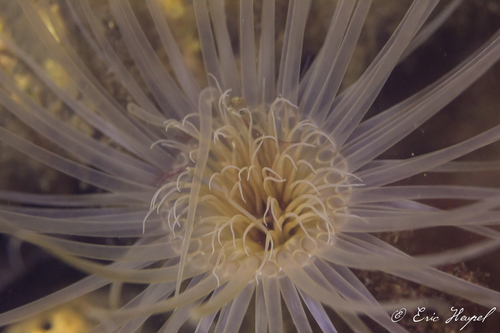
About Ceriantheopsis americana (Agassiz, 1864)
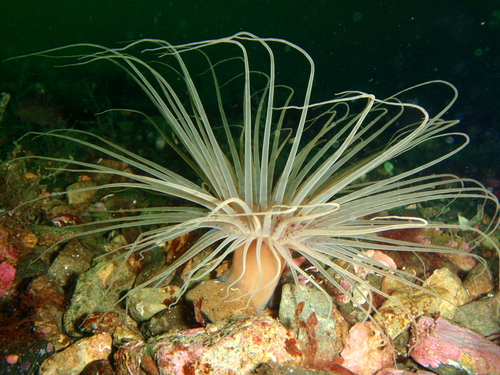
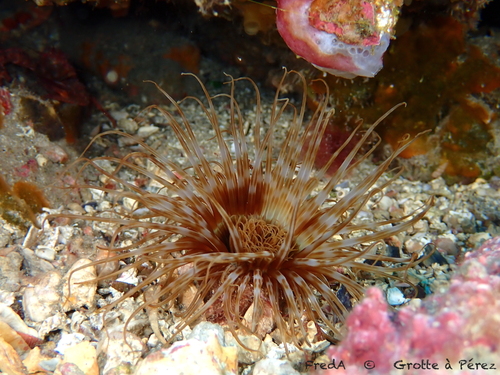
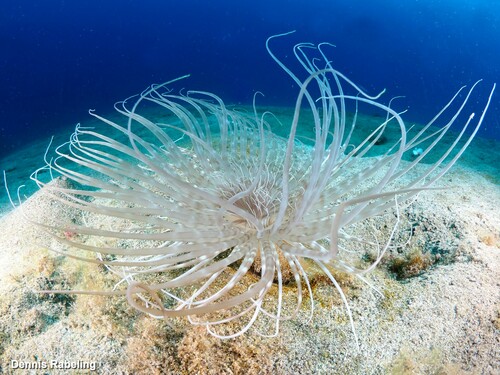
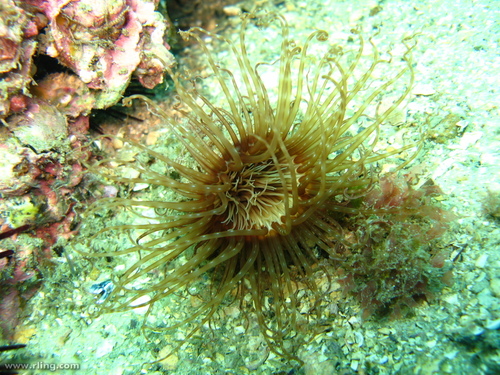
Ceriantheopsis americana (Agassiz, 1864) is a large tube-dwelling anemone. Its crown of tentacles can reach a diameter of up to 10 cm (4 in), and extends 10 cm above the sediment surface. This anemone has a slender, elongated body, and builds a tough, felted, leathery tube to line its burrow. It constructs the tube from discharged cnidocytes bound together with mucus, and incorporates sand grains into the tube's outer surface. The tube is positioned vertically in the sediment, with a maximum length of about 35 cm (14 in). A short connecting lateral tube often branches off near the upper end of the main tube. The top entrance of the tube is somewhat elastic, measures up to 1.5 cm (0.6 in) in diameter, and the tube narrows toward its base. Ceriantheopsis americana is native to the western Atlantic Ocean, where it occurs between Maine and Cape Hatteras in the United States. It inhabits soft substrates in the sublittoral zone and the lowest parts of the littoral zone in sheltered areas, and is most common just below the low tide mark. During the day, this anemone retreats into its tube and closes the entrance. As evening comes and at night, it extends its crown of tentacles and spreads the longer tentacles around the tube entrance. It is a predator that feeds mostly on planktonic calanoid copepods and bottom-dwelling harpacticoid copepods. It also eats barnacles, amphipods, and gastropod molluscs. Ceriantheopsis americana is abundant in Narragansett Bay, Rhode Island, but was overlooked for a long time, most likely because it retreats into its burrow when disturbed. In this area, the anemone seems to disappear after mid-August, then reappears in mid-October. This apparent disappearance is likely caused by the anemone burrowing deeper into the substrate to avoid being eaten by scup (Stenotomus chrysops) when schools of young scup move inshore. When the fish leave again in the fall, the anemone reappears at similar sizes and population densities as before. Examination of the stomach contents of young scup supports this hypothesis.