About Cereus repandus (L.) Mill.
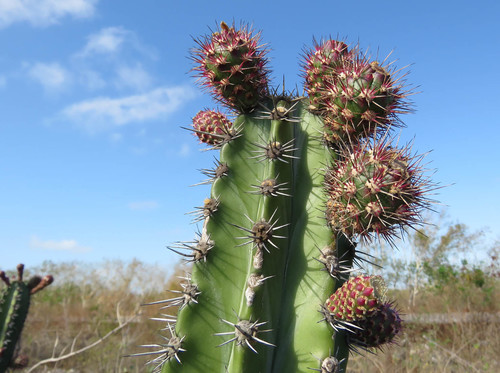
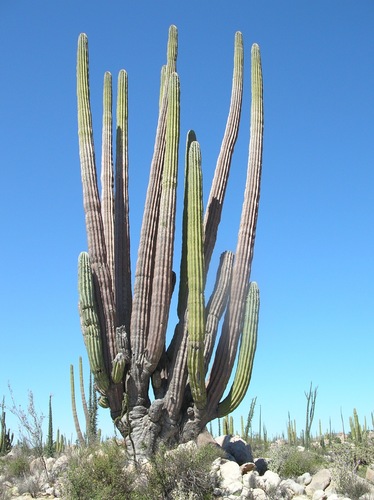
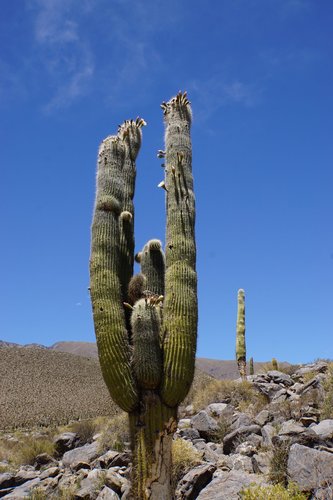
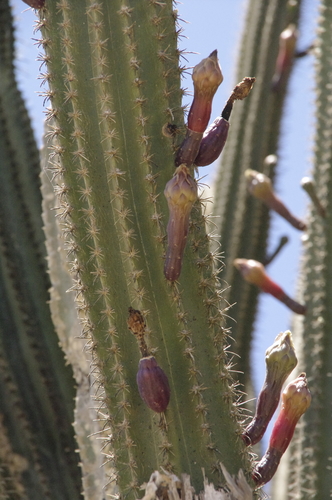
Cereus repandus (L.) Mill. typically has a tree-like growth form. As a self-supporting plant, its cylindrical gray-green to blue stems can grow up to 10 metres (33 feet) tall, with a diameter between 10 and 20 centimetres. This cactus has nine to ten rounded ribs that reach up to 1 centimetre in height. Its small areoles are spaced far apart. It produces gray, needle-like thorns that vary a lot in development: they are often numerous, but may also be completely absent. The longest thorns can reach up to 5 centimetres long. Its large, cream-colored flowers are nocturnal, only open for one single night, and play a vital role for pollinating bats. The fruits of this species are known locally by common names: pitaya, olala (a name used only in some parts of Bolivia), or Peruvian apple. These fruits are thornless, and their outer skin colour ranges from violet-red to yellow. They contain edible white flesh that holds small, edible, crunchy seeds. The flesh of the fruit sweetens as it fully opens out. Because this cactus grows in arid regions and produces fruit during the dry season, its fruit is an essential source of food for birds across its native range. Cereus repandus is frequently confused with other species in the genus Cereus, including Cereus forbesii, Cereus jamacaru, Cereus hildmannianus, and Cereus hexagonus.