About Cereopsis novaehollandiae Latham, 1801
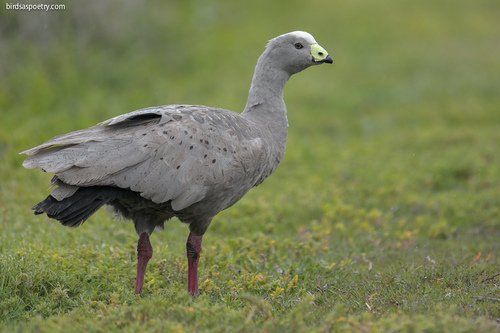
Adult Cape Barren geese (Cereopsis novaehollandiae Latham, 1801) are large birds, typically measuring 75–100 cm (30–39 in) long and weighing 3.7–5.2 kg (8.2–11.5 lb), with males generally larger than females. Their plumage is mostly pale grey with a slight brown tint. The head is somewhat small relative to the body and mostly grey, except for a pale whitish patch on the forehead and crown. The bill is short at 56–63 mm (2.2–2.5 in), triangular-shaped and black, with a prominent pale yellow-green cere covering more than half the bill's length. Feathers on the breast and back have pale margins, while upperwing coverts and scapular feathers each have a brownish grey spot near the tip. Flight feathers are grey with black tips; the black extends to cover the distal half of the outer primaries, creating a dark trailing edge on the wings when flying. The tail feathers are black, and legs are pink with black feet. Newly hatched goslings are white with broad dark stripes and a dark cere. Older juveniles are paler grey with heavier spotting on the wings and scapular feathers than adults. The cere shifts to light yellow-green at around 70 days old, and juveniles molt into adult plumage at around 6 months old. A previous population decline of this species has been reversed, at least for eastern birds, which have adapted to feeding on agricultural land. Breeding areas are grassy islands off the Australian coast, where the species nests on the ground. Breeding pairs are strongly territorial. The species tolerates captivity well, and readily breeds in confinement if provided with large enough paddocks. In Australia, 19th-century explorers named a number of islands "Goose Island" due to this species' presence there. Cape Barren geese were unsuccessfully introduced to New Zealand at least three times between 1869 and 1874. The only successful introduction to the region was in 1914–15 at Lake Hāwea and Lake Wānaka, which produced a small breeding population that persisted until 1946. A small population introduced near Christchurch, New Zealand, still persists today. In 1968, a small number of geese were introduced to Maria Island.