About Cercopithecus neglectus Schlegel, 1876
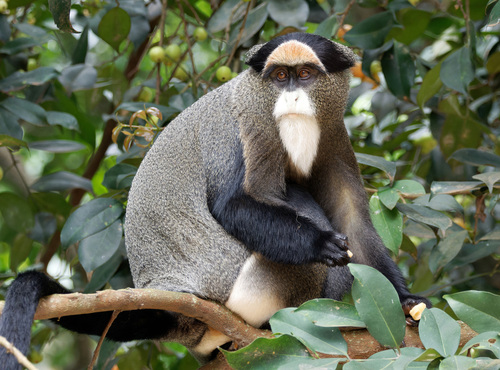
De Brazza's monkey (Cercopithecus neglectus Schlegel, 1876) is the most sexually dimorphic guenon species: males weigh around 7 kilograms, while females weigh around 4 kilograms. Adult De Brazza's monkeys have grey agouti fur, a reddish-brown back, black limbs and tail, and a white rump. Individuals of both sexes have cheek pouches, which they use to carry food while foraging. Males have a distinct blue scrotum; females have a red perianal region and visible nipples. Juveniles do not have the darker adult coloration on the extremities, but they retain white stripes and a red rump. Infants are a uniform brown agouti, and only have a small beard. A white muzzle and beard, an orange crescent on the forehead, and white stripes on the thighs set this species apart from other guenons. Because of this distinctive appearance, the monkey is sometimes called the "Ayatollah Monkey", named for Ruhollah Khomeini, the similarly bearded Grand Ayatollah. De Brazza's monkeys range across swamps, bamboo stands, and dry mountain forests across Angola, Cameroon, the Central African Republic, the Republic of the Congo, the Democratic Republic of the Congo, Equatorial Guinea, Ethiopia, Gabon, Kenya, South Sudan, Nigeria, and Uganda. They may also be present in Tanzania, though these reports have not been confirmed. Troops are found almost exclusively near water, and rarely travel farther than 1 km away from a river or tributary. Because of this habit, they can sometimes be seen swimming. The monkeys prefer dense forest and thick vegetation, and only enter more open forest areas to feed. They are mainly arboreal, but descend to the ground to feed on herbaceous plants. Due to the species' cryptic nature, there is no accurate population estimate for the entire range of De Brazza's monkey. Female De Brazza's monkeys reach sexual maturity around 5 years of age, while males do not reach maturity until closer to 6 years of age. Most juvenile males leave their natal group before they reach maturity. The main breeding season runs from February to March, though females can also enter estrus during periods of high food availability. Gestation lasts between 5 and 6 months. An infant stays close to its mother for the first year of life, when it is weaned. Females usually give birth to one infant at a time. Twins are born only rarely, and there is a one-year interval between successive births.