About Cercopithecus mitis Wolf, 1822
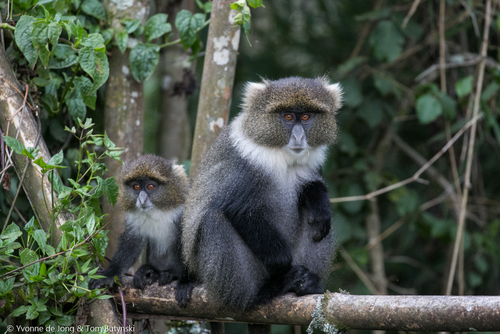
Like other mammals with "blue" in their name, such as the blue tick hound and blue wildebeest, the blue monkey often has a slaty-grey tint that can appear blue to observers. Its main body color is olive or grey, which differs from the color of other body parts: its face is dark, with a pale or yellowish patch on the forehead that forms the "diadem" for which the species is named; it also has a blackish cap, blackish feet, and blackish front legs, while its mantle can be brown, olive, or grey depending on the subspecies.
This monkey typically measures 50 to 65 cm (20 to 26 in) in head-and-body length, not counting its tail which is almost as long as the rest of its body. Females weigh a little over 4 kg (8.8 lb), while males can reach up to 8 kg (18 lb).
Blue monkeys live in evergreen forests and montane bamboo forests, and they spend most of their time in the forest canopy, coming down to the ground very rarely. They are highly dependent on humid, shady areas with abundant water. Their diet is mainly made up of fruit and leaves, but they will also eat some slower-moving invertebrates. They prefer to live in tall trees that provide both food and shelter. Like almost all guenons, they are negatively impacted by the loss of their natural habitat. When natural forest is replaced by pine plantations, foresters often consider blue monkeys a threat, because the monkeys sometimes strip bark from these introduced trees to search for food or moisture. Blue monkeys are also hunted for bushmeat, and killed in retaliation for raiding crops.
Blue monkeys have a polygynous mating system, which corresponds to size-based sexual dimorphism, with males being substantially larger than females. Females usually give birth once every two years, at the start of the warm, rainy season; gestation lasts around five months. Infants are born with fur and their eyes already open.
Blue monkey social groups range in size from 10 to 40 members, and contain only a single adult male. They are often found living in mixed groups with other monkey species, such as the red-tailed monkey and various red colobus monkeys. In this species, males mate with multiple females, while females only mate with the single adult male in their group. Females use body language to attract males for mating. While breeding can occur throughout the year, most births happen at the start of the warm rainy season. Groups can contain up to 40 members, and females typically help care for all the young in the group, not just their own offspring.