About Cercopithecus ascanius (Audebert, 1799)
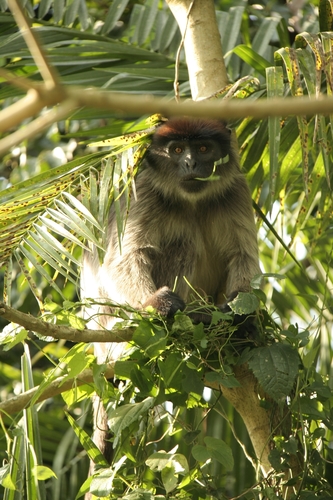
The red-tailed monkey, scientific name Cercopithecus ascanius, has several other common names: black-cheeked white-nosed monkey, red-tailed guenon, redtail monkey, and Schmidt's guenon. It is a primate species belonging to the family Cercopithecidae. It has confirmed recorded presence in Angola, the Central African Republic, the Democratic Republic of the Congo, Kenya, Rwanda, South Sudan, Tanzania, Uganda, and Zambia, and may also be found in Burundi. This species typically has black, red, or orange fur. Though native to Central and East Africa, it has spread both north and south, and can survive in a range of habitats and conditions. It is a distinct species in its native habitats, and is gradually becoming endangered due to deforestation, over-exploitation from hunting, and predation. Red-tailed monkeys are diurnal, and are most active during early morning and evening. They act as important seed dispersers, because they collect fruit and other food items. This species is distributed across the tropical forests of East and Central Africa, ranging to Kenya and many areas of the Congo. There are multiple recognized subspecies, each with different ranges. The subspecies C. a. schmidti has the widest distribution, stretching from the Congo into Kenya, Tanzania, and Uganda. The subspecies C. a. atrinasus has the smallest distribution, restricted to the local habitat of Zovo, Angola. Red-tailed monkeys are primarily arboreal, but will come down to the ground. They are much more active and travel faster in trees than on the ground. When on the ground, they travel quadrupedally, meaning they move on all four legs. While they strongly prefer to be active and rest in trees, they forage on the ground, so they spend a considerable amount of time on the forest floor as well. Like all placental mammals, red-tailed monkeys give birth to live, viviparous young. They usually only produce one offspring per mating season. Their mating system is polygynous: one male mates with multiple females, a trait common among mammals that brings advantages to their grouped social system. Their most prominent and successful mating season runs from November to February, though breeding can occur throughout the entire year. Studies have recorded that red-tailed monkeys can interbreed and produce hybrids with another species in their genus: the blue monkey (C. mitis). These hybrids have been observed at Gombe, Tanzania, a terrestrial island. This hybridization could play an important role in the reproduction of both red-tailed and blue monkey species, and may potentially lead to the emergence of a new species in the future.