About Cercomacra tyrannina (P.L.Sclater, 1855)
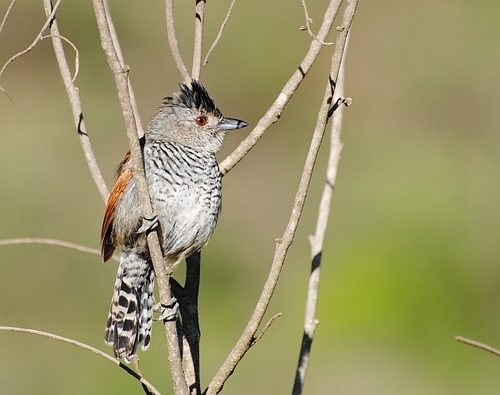
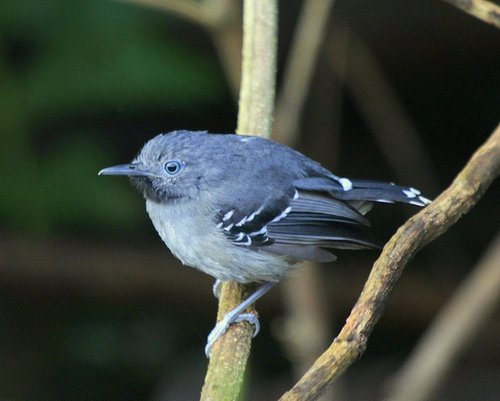
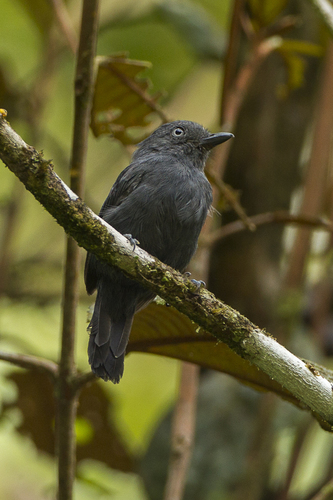
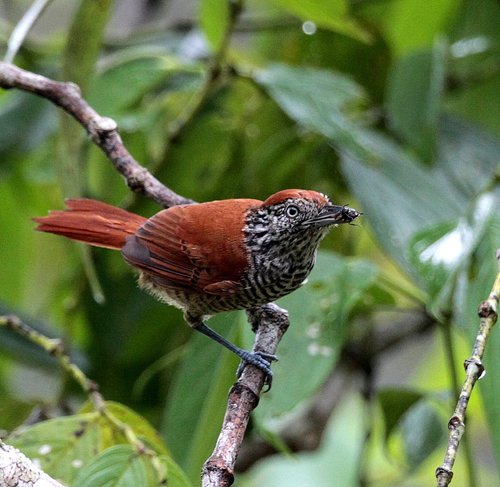
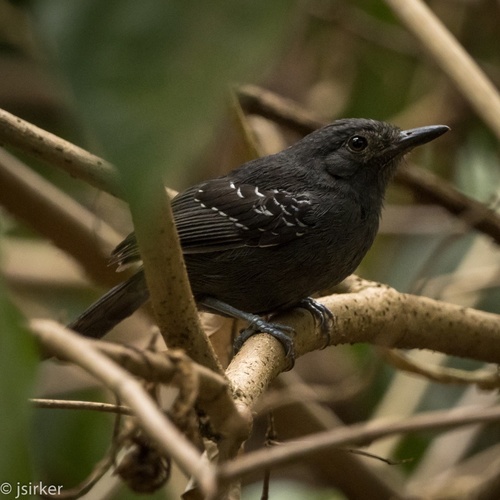
The dusky antbird (scientific name Cercomacra tyrannina, first described by P. L. Sclater in 1855) measures 13 to 15 cm (5.1 to 5.9 in) in length and weighs 15 to 19 g (0.53 to 0.67 oz). Males of the nominate subspecies C. t. tyrannina are mostly slate gray, with darker wings and tail and lighter underparts. They have a white patch between their scapulars, narrow white tips on their wing coverts and outer tail feathers, and a clay-colored tinge on their posterior underparts. Females of the nominate subspecies have dark olive-gray crown, upperparts, and wings with a tawny tinge, a very small white interscapular patch, cinnamon edges on their wing coverts, and a dark grayish brown tail. Their supercilium, throat, and underparts are tawny-buff, with an olive tinge on their flanks. Each of the other recognized subspecies has distinct plumage differences from the nominate. Males of C. t. crepera are blacker than nominate males, with smaller white tips on their wing coverts and tail, while C. t. crepera females have more rufescent wings than nominate females. Males of C. t. vicina have brownish olive wings, tail, and flanks. Males of C. t. saturatior are blacker than the nominate, with white tips on the feathers of the crissum and usually white tips on some breast feathers, while C. t. saturatior females have grayer upperparts than nominate females. Adult individuals of both sexes across all subspecies have a rich chocolate-brown iris. The four subspecies have distinct geographic ranges across Central and South America. C. t. crepera is found from Veracruz and Oaxaca in southern Mexico, south through Belize, Guatemala, Nicaragua, and Costa Rica, into Panama as far as northwestern Veraguas Province. C. t. tyrannina occurs in Panama from eastern Chiriquí Province to Colombia; within Colombia, it is found on the Pacific slope, in the lower Cauca and Magdalena river valleys, and in the Central and Eastern Andes; it also ranges through western Ecuador south to Guayas Province, southern Venezuela's Bolívar and Amazonas states, and far northwestern Brazil's northern Amazonas state. C. t. vicina occupies the eastern and western Andes of northwestern Venezuela and the east slope of Colombia's Eastern Andes. C. t. saturatior ranges from southern and eastern Bolívar in Venezuela, east through the Guianas and northeastern Brazil north of the Amazon, to the Atlantic coast in Amapá. The dusky antbird lives in the understorey of evergreen forest, and it overwhelmingly favors forest edges, clearings, and the edges of watercourses. It also occurs in secondary forest, but only in secondary forest that borders taller forest and has a dense understorey. Its maximum elevation range varies by region: it can be found as high as 1,250 m (4,100 ft) in Central America, 2,000 m (6,600 ft) in Colombia, up to 1,800 m (5,900 ft) in Venezuela (though it occurs mostly below 1,200 m (3,900 ft) there), up to 1,200 m (3,900 ft) in Brazil, and locally up to 1,400 m (4,600 ft) in Ecuador (though it occurs mostly below 800 m (2,600 ft) there).