About Cercomacra nigricans P.L.Sclater, 1858
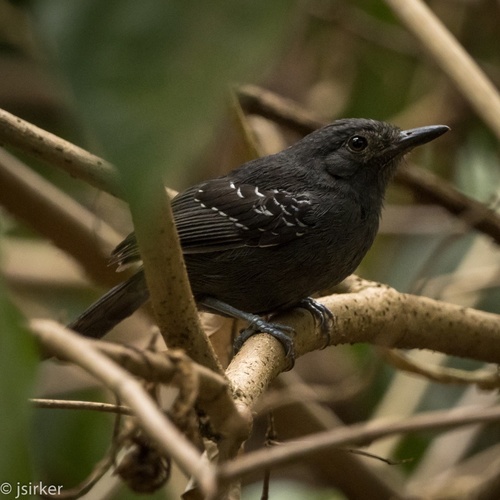
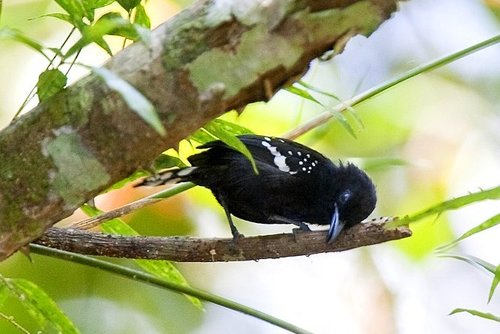
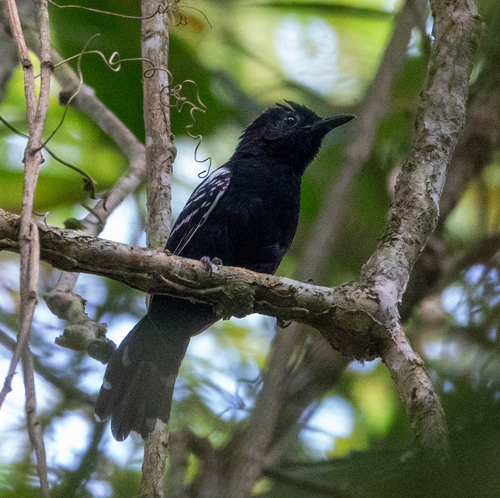
The jet antbird (scientific name Cercomacra nigricans P.L.Sclater, 1858) measures 14 to 15.5 cm (5.5 to 6.1 in) in length and weighs 15 to 17.5 g (0.53 to 0.62 oz). Adult males are almost entirely black. They have white edges on their outer scapulars, a white patch between the scapulars, and a hidden white patch under them. Their wing coverts and tail feathers have white tips, and their flight feathers have white inner edges. Adult females are mostly blackish gray, with white markings in the same locations that males have them. Females also have a whitish ring around the eye, thin white streaks on the throat and breast, and white barring on the lower belly. Juvenile males are dull brown, with narrow white tips on their tail feathers. Subadult males have similar plumage to adult females, but with heavier markings. The jet antbird has a disjunct distribution split into four separate populations. One population occurs from central Panama south into northern and western Colombia. A second population stretches from central Colombia northeast through western Venezuela. A third population is centered along the Orinoco River in eastern Venezuela. The fourth extends along most of the length of western Ecuador. The species' habitat varies by geographic location. It occupies subtropical humid forest in Panama and Venezuela, and drier deciduous forest and woodlands in Colombia and Ecuador. Across all forest types, the jet antbird favors mature secondary forest and the edges of primary forest that have a thick understorey of vines and shrubs. It is usually found near swampy areas or watercourses. In terms of elevation range, it reaches up to 600 m (2,000 ft) in Venezuela, 1,500 m (4,900 ft) in Colombia, and 500 m (1,600 ft) in Ecuador.