About Cercidiphyllum japonicum Siebold & Zucc.
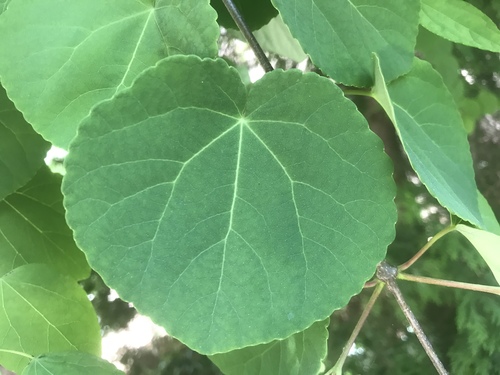
This deciduous tree, Cercidiphyllum japonicum Siebold & Zucc., grows 10 to 45 meters tall, with a trunk diameter that reaches up to 2 meters, and rarely exceeds this size. Its shoots are dimorphic: long shoots form the branch structure, while short shoots develop starting from the shoots' second year of growth. Leaves grow in opposite pairs on long shoots, and singly on short shoots. Each leaf has a 1.4 to 4.7 cm long petiole, a rounded shape, a heart-shaped base, and a crenate margin. Leaves on short shoots are larger, measuring 3.7 to 9 cm long and 5 to 8.3 cm broad; leaves on long shoots are smaller, measuring 3.2 to 4.5 cm long and 1.9 to 3.2 cm broad. In autumn, leaves turn a range of pink and yellow shades, and fresh autumn-colored leaves sometimes carry a distinctive caramel scent. The species is dioecious, meaning male and female flowers grow on separate individual plants; flowers are inconspicuous and appear in early spring alongside newly opening leaves. The fruit is a cluster of two to four follicles, each 1 to 1.8 cm long and 2 to 3 mm wide, with each follicle holding several winged seeds. Katsura, the common name for this tree, is a popular ornamental tree in Japan and many other regions. In Japan, it is also cultivated for its timber, which is used in construction and woodworking. Several cultivars are grown, including 'Aureum', 'Heronswood Globe', and 'Ruby'. As of 2017 confirmation, the following hold the Royal Horticultural Society's Award of Garden Merit: unimproved C. japonicum, C. japonicum 'Heronswood Globe', and C. japonicum f. pendulum.

