About Cercibis oxycerca (Spix, 1825)
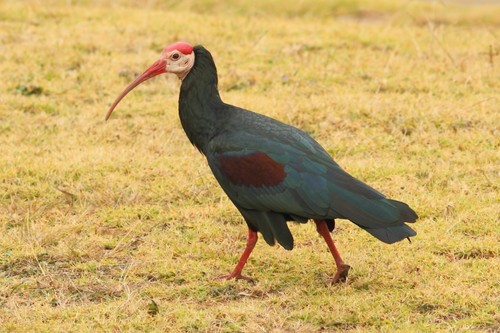
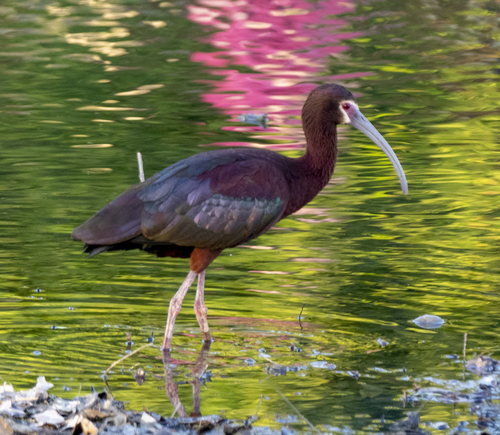
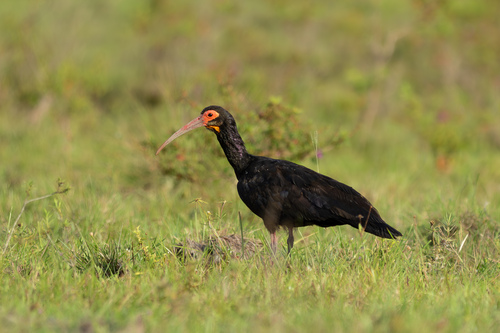
Description: This large ibis, Cercibis oxycerca, measures 75–86 cm in total length, with males being slightly larger than females. For adult males, the flat wing length is 390–415mm, and the culmen (measured from the base of the bill) is 156–168mm. For adult females, the wing length is 376–413mm, and the culmen length is 144–197mm. The species is set apart by its notably long tail, the longest of any living ibis species; tail length measures 250–301mm in males and 256–272mm in females. When the bird stands, the tail extends past the tips of its folded wings, and when in flight, it extends past the trailing legs. Its plumage is mostly black with a greenish gloss, and has purplish tinges on the upper back, hindneck, wings, and tail. The forehead and cheek area is sometimes greyish brown. Juveniles look similar to adults, but their plumage does not have a metallic sheen. The bill, legs, toes, and bare facial skin are orange-red; the throat is yellowish-orange, and a feathered grey strip runs below the eye starting from the lower mandible. An inconspicuous fuzzy crest runs down the back of the head and upper neck. The iris is greyish red, but can sometimes be scarlet red, a difference that may be linked to breeding. However, nothing is known about changes to soft part colouration during courtship. Overall, the sharp-tailed ibis is superficially similar to many co-occurring ibises such as the glossy ibis and the bare-faced ibis, but is clearly distinct due to its longer tail and larger body size. This ibis is especially vocal. Its call is a loud, distinct single or double cuk or turuck, or kut and kut-kaaaoh. These calls sound similar to a saxophone or toy trumpet. Flight calls have been described as a long drawn-out tuuut, a repeated cuk cuk cuk cuk, and a loud nasal TUUR-DEE. It is thought that males produce the TUUR element, and females respond with the following DEEE. The timbre of the TUUR-DEE call gave the species its local Spanish name Tarotaro. The sharp-tailed ibis has a slow, laboured flight; individuals fly low above the ground and often only travel short distances, such as between adjacent trees. That said, they have been observed flying across wide open grassland to reach roosting or feeding sites. Due to its loud wing beats, it can often be heard before it becomes visible. Distribution and habitat: The sharp-tailed ibis lives in wet lowland savannas and riverbanks of northern South America east of the Andes, at elevations below 300–500m above sea level. It is native to Venezuela, eastern Colombia, southwestern Guyana, Brazil, and Suriname. In Venezuela, it is most often found along or near the Orinoco and Apure rivers. In the llanos of eastern Colombia, it occurs along the Casanare and Cravo Sur rivers, as well as the Colombian portion of the Apure. In Brazil, it is often found northwest of the Amazon, and often occurs in grasslands near the Rio Negro and Rio Branco. It is also present further west near Rio Guanco and to the south in northwestern Mato Grosso. This ibis sometimes uses gallery forests for roosting and breeding. This ibis has a patchy distribution across its entire range, and despite having a relatively large total population, it is generally uncommon at the local level, and is considered the least numerous ibis species in the Venezuelan llanos. It is more abundant there during the rainy season, however. It does not associate with other wading bird species, and often keeps distance from birds of other species. It is primarily found in male-female pairs, and in small single-species groups of three to five individuals. Even though this ibis is territorial, individuals very rarely forage alone. The two birds in a pair differ noticeably in body size, which suggests they are a paired male and female matching the known size differences between the sexes. Groups of more than two individuals appear to consist of a paired male and female along with their juvenile offspring. In observations of flocks of three, the individual assumed to be the offspring is noticeably smaller with less developed facial colourations. Food and feeding: Like the co-occurring glossy ibis, the sharp-tailed ibis feeds mostly on land or semi-terrestrially, either in open areas or in short grass. It typically forages in moist soil, shallow mud, and along marshy edges of lagoons and rice fields. It only occasionally forages in shallow water of 3cm depth or less. It is less tied to aquatic habitats for feeding than many other South American ibises. Across the sharp-tailed ibis's range, only the buff-necked ibis forages on drier, higher-altitude ground. More rarely, the sharp-tailed ibis has been observed foraging in gallery forests during the wet season. This species feeds primarily by touch. Its typical foraging method involves walking quickly across moist soil, shallow mud, or shallow water, and probing deeply into the moist underlying substrate for prey at regular intervals. It is fairly flexible in its use of microhabitats, foraging on both open ground and in short grass. Multiple individuals have been observed with dried mud along the length of their bills. Its foraging behaviour closely resembles that of the glossy ibis and buff-necked ibis. Even though their niches overlap considerably, the sharp-tailed ibis may be more active during the morning than other co-occurring ibises, which suggests temporal niche partitioning. There may also be differences between these co-occurring ibis species in specific dry-season probing depths and microhabitat use within the large-scale savannas. The sharp-tailed ibis feeds mainly on medium-sized insects, especially during the dry season. It also occasionally eats amphibians, crustaceans, earthworms, and snails. Its tendency to forage in pairs or small groups may be partially explained by the dispersed distribution of its insect prey in the llanos. This ibis probably moves locally to higher altitude feeding grounds during the wet season, which may act as a refuge from widespread flooding of lowland grasslands. Its persistence as a primarily terrestrial forager in its semi-aquatic habitat suggests that its relatively dry, higher-altitude feeding grounds that remain unflooded in the wet season are extensive enough, or that the dry season is long enough to maintain high annual prey availability in the lowlands.