About Cercartetus concinnus (Gould, 1845)
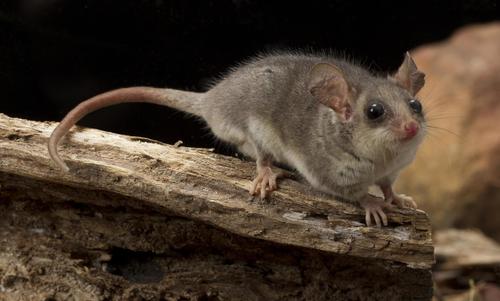
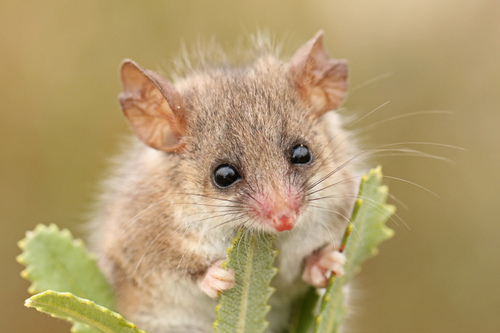
The western pygmy possum, Cercartetus concinnus, is unusual among species of the Cercartetus genus. Unlike its grey relatives, most of its body fur is bright cinnamon, and it has pure white underparts that further distinguish it from close relatives. It has a thin ring of dark brown fur in front of the eyes, long rounded flesh-coloured ears, and large black protruding eyes. Its muzzle is only sparsely covered in hair, revealing pink colour on its bare areas. The species also has long whiskers.
Its prehensile tail is long, covered in fine scales instead of fur, and is not enlarged at the base. The first digits on its hind feet are opposable, and all four feet have broad pads at the tips of the toes. While it is small compared to most other possums, it is one of the larger pygmy possum species. Adult head-body length ranges from 70 to 100 millimetres, and the tail is 70 to 90 millimetres long. Adult weight ranges from 8 to 18 grams. Females have a well-developed forward-opening pouch that contains six teats. For an animal of its small size, its tongue is unusually large, reaching up to 12 millimetres in length.
This species is considered vulnerable due to habitat loss and lack of food. Its distribution includes Southwest Australia, including the south coast and wheatbelt, as well as areas of South Australia, Kangaroo Island, and Victoria extending south to Edenhope. It is also found in far southwestern New South Wales, where it is listed as endangered. It lives in semi-arid woodland, shrubland, and heath, which are dominated by plants such as Callistemon (bottlebrushes), melaleuca, banksia, and grevillea. It was previously thought that there were two subspecies separated by the Nullarbor Plain, but genetic studies have not found any significant difference between eastern and western populations. Fossils of the species are known from the Nullarbor Plain region, though it is no longer native to this area.
Western pygmy possums can breed throughout the year, though breeding is most common in spring. They give birth to litters of four to six young. Mothers often carry more than six embryos at a time in their womb, but since they only have six teats, and marsupial young stay attached to an individual teat for most of their early development, six is the maximum number of young a mother can successfully rear. Unusually, a mother may give birth just two days after weaning a previous litter. Her teats change dramatically in size to accommodate the smaller new young, and her mammary glands revert to producing colostrum.
The young are still blind when they leave the pouch at around 25 days of age. After leaving the pouch, they initially stay within the nest, and are fully weaned at around 50 days. Females reach sexual maturity at 12 to 15 months old.