About Cerbera odollam Gaertn.
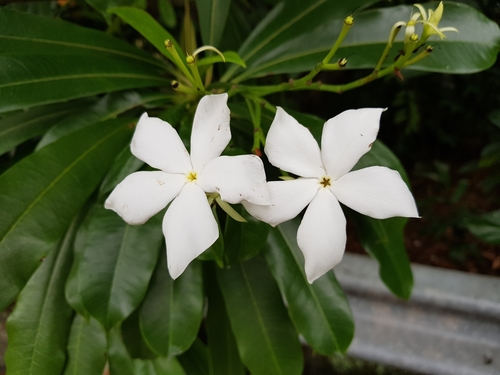
Cerbera odollam Gaertn. closely resembles oleander, another highly toxic member of the same plant family. It reaches an approximate height of 10–12 meters, produces glossy leaves, and bears white flowers with yellow throats. The entire plant produces a milky white latex. Its fruits are around 5–10 centimeters long; they start green and turn red as they mature. Each fruit has a green fibrous outer shell that encloses an ovoid kernel measuring roughly 2 cm × 1.5 cm, which holds two extremely poisonous seeds. When exposed to air, the initially white kernel changes color first to violet, then to dark grey, and finally to brown or black.
The toxic compound found in Cerbera odollam kernels is cerberin, a cardiac glycoside that blocks the sodium-potassium ATPase pump in the heart. A single kernel contains enough toxin to produce a fatal dose.
Cerbera odollam is commonly used in both homicidal poisonings and suicides. Its bitter flavor can be easily masked by spicy food, so victims often ingest the toxin without noticing. In Kerala, this species causes around 50% of all plant poisoning cases and 10% of all poisoning cases overall. Fatalities from poisonings involving this plant are widely underestimated, because standard toxicology testing for the toxin is not available in most cases. Poisonings occurring outside the tree’s natural range are considered rare.
The poisonous kernels of Cerbera odollam were historically used in trials by ordeal, similar to the tangena practice, across all regions where the plant grows. In 18th and 19th century Madagascar, over 3,000 people died each year from consuming these seeds during trial by ordeal. These trials were held to determine if a subject was guilty of a crime, most often witchcraft. During the trial, a dose of seed was given to the accused: if the subject survived, they were considered innocent of the crime they were accused of, while death was taken as a sign of guilt. The practice relied on the belief that a supernatural spirit would intervene to distinguish between innocence and guilt, and trials using cerberin were extremely common. In the mid-1800s, Madagascan leaders attempted to regulate the practice of trial by ordeal, substituting dogs or chickens for human subjects in cases involving minor crimes. However, the practice did not end until the early 1900s.
Cerbera odollam has also long been frequently used for suicide, and it continues to be used for this purpose in modern times. A 2004 study recorded that between 1989 and 1999, the plant was responsible for roughly one suicide death per week in Kerala, India. People who use the plant for suicide remove the kernels from the seeds, combine them with jaggery, and eat the mixture. Death occurs rapidly, typically between 3 and 6 hours after ingestion.
In modern applications, the seeds of C. odollam are used as biopesticides, insect repellents, and rat poisons, due to their natural toxicity to these animals. Researchers have also investigated whether the seeds can be used as a feedstock for biodiesel production. Oil can be extracted from the seeds and transesterified into fatty acid methyl esters. This plant is considered a good alternative to other common biodiesel feedstocks because it grows on land that is typically non-arable, so it does not compete with food crops for agricultural space.