About Ceratotherium simum (Burchell, 1817)
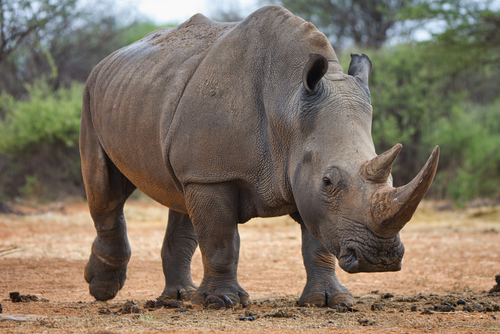
The white rhinoceros, scientifically named Ceratotherium simum (Burchell, 1817), is the largest of the five living rhinoceros species, and one of the largest extant megafauna. When ranked by mean body mass, only the three living elephant species are larger than it. While the body mass of individual white rhinos often overlaps with that of individual hippopotamuses (which share the white rhino's habitat), white rhinos have a higher average body mass. The white rhino's large mass is reflected in its large barrel-shaped body and immense head, connected by a short, powerful neck. Male (bull) white rhinos typically have a head-and-body length of 3.7–4 m (12.1–13.1 ft) and a shoulder height of 170–186 cm (5.58–6.10 ft). Female (cow) white rhinos have a head-and-body length of 3.35–3.65 m (11.0–12.0 ft) and a shoulder height of 160–177 cm (5.25–5.81 ft). The tail adds approximately 70 cm (28 in) to the animal's total length. Bulls are heavier than cows, averaging 2,000–2,300 kg (4,410–5,070 lb) compared to cows' average 1,600–1,700 kg (3,530–3,750 lb). Specimens up to 3,600 kg (7,940 lb) have been reliably recorded, but claims of individuals reaching 4,500 kg (9,920 lb) are still unverified, so the species' maximum attainable size is not definitively known. The white rhinoceros's most recognizable features are two large horn-like structures arranged one behind the other on its snout. These structures are not true bovid horns (which have a bony core), nor are they bone antlers like those of deer. Instead, they are solid masses of densely compacted keratin fibers, the same protein that forms human hair and fingernails. The anterior (front) horn is usually the larger and more prominent, averaging 60 cm (24 in) in length, and can reach up to 166 cm (65 in) in some individuals, particularly cows. A single horn can weigh around 4.0 kg (8.8 lb), demonstrating its dense, substantial structure. A prominent muscular hump sits on the back of the neck, which is critical to supporting the weight of the animal's massive head during long grazing sessions. Because white rhinos often wallow in mud, their thick, typically grey armor-like skin often takes on the color of local soil, ranging from yellowish-brown to darker slate. This wallowing behavior protects the rhino from the harsh African sun and provides relief from biting insects. The only visible hair on a white rhino is sparse, found mostly as fine fringes on the ears and short bristles on the tail. Its sturdy, pillar-like legs end in broad, stumpy feet, each with three large toes that splay slightly to effectively distribute the animal's weight across different types of terrain. The white rhinoceros's most distinctive feeding adaptation is its broad, straight, square-lipped mouth, which lets it graze efficiently, cropping wide swathes of grass with each bite. White rhinos have relatively poor vision, and rely more heavily on their other well-developed senses. Their large, tubular ears can swivel independently across a wide arc, letting the rhino accurately detect the direction of even subtle sounds and identify potential threats, especially in dense vegetation. White rhinos also have a highly developed sense of smell; their olfactory passages are actually larger than their brain, and their muzzle has the widest set of nostrils of any land animal. The southern white rhinoceros (Ceratotherium simum simum), a subspecies of white rhino, is found predominantly in Southern Africa, and its recovery is a major conservation success story. After being nearly extinct in the early 20th century, this subspecies made a remarkable population recovery. At the end of 2023, the wild southern white rhino population was estimated at 17,464 individuals, making it the most numerous rhinoceros subspecies. The vast majority of these animals live in South Africa (approximately 12,968 in 2021), with other large populations located in Namibia, Botswana, Zimbabwe, and Kenya. Smaller populations, many established through reintroduction efforts, also live in Eswatini, Uganda, and Zambia, with a small number remaining in Mozambique. In sharp contrast, the northern white rhinoceros (Ceratotherium simum cottoni) is critically endangered and on the brink of extinction. Historically, its range covered multiple countries in East and Central Africa, including northwestern Uganda, southern Chad, southwestern Sudan, the eastern Central African Republic, and northeastern Democratic Republic of the Congo (DRC). The subspecies' last confirmed wild population was in Garamba National Park in the DRC. However, relentless poaching caused a catastrophic population decline; surveys in August 2005 found only four individuals left in Garamba, and by June 2008, it was widely reported that the northern white rhino might be extinct in the wild. Currently, the subspecies is considered possibly extinct in the wild, with only two females remaining under managed care in Kenya. Both white rhinoceros subspecies have faced severe threats from habitat loss, and most damagingly, ongoing poaching. Organized poaching syndicates, which historically included groups like the Janjaweed in some regions, have drastically reduced white rhino numbers. The main driver of this illegal trade is the high value placed on rhino horn in some traditional Asian medicines, despite a complete lack of scientific evidence supporting any medicinal benefits, and increasingly, its use in ornamental carvings and as a status symbol. White rhinos are specialized grazing herbivores that live primarily in grassland and savanna ecosystems. They prefer the shortest grass grains, and are counted among the largest dedicated grazers. Around half of each day is spent feeding, about one third resting, and the rest on other activities. When water is easily available, they usually drink twice a day, but they can survive four to five days without water in arid conditions, showing notable resilience. Like all rhinoceros species, white rhinos regularly wallow in mud, coating their skin to help with thermoregulation, prevent sunburn, and repel biting insects. As megaherbivores, white rhinos are considered important ecological engineers; their grazing patterns shape grassland structure and savanna ecology. Similar to African elephants, they are thought to be a key driving factor in their ecosystems, and the loss of these large herbivores can cause serious cascading negative effects that can harm many other species. White rhinos use a range of vocalizations to communicate. These include a panting contact call, grunts and snorts during courtship, squeals of distress when alarmed, and deep bellows or growls when threatened. Threat displays, especially from bulls, include visually intimidating behaviors such as wiping horns on the ground and holding a head-low posture with flattened ears, often paired with aggressive snarls and shrieks if an attack is coming. Vocalizations differ noticeably between northern and southern white rhinoceros, and even panting contact calls vary between individuals within each subspecies, which supports individual recognition and long-distance communication. Despite their large size, white rhinos are surprisingly fast and agile, able to run at speeds up to 64 km/h (40 mph). Socially, white rhinos often form groups called crashes or herds, which usually hold up to 14 individuals, mostly females and their calves. Sub-adult bulls may also gather together, and sometimes associate with an adult cow. Most adult bulls, however, live solitary lives. Dominant bulls are highly territorial and spend significant effort marking their territory. They create distinct dung piles called middens; a single bull may maintain 20 to 30 middens to signal his presence to other rhinos. Other marking behaviors include rubbing horns on bushes or the ground and scuffing the earth with feet before spraying urine. These patrols and marking activities can happen frequently, sometimes up to ten times an hour within a bull's territory. A similar scrape-marking ritual, without urine spraying, is also a common territorial display. In contrast, subordinate bulls do not establish or mark territories. The most severe conflicts between bulls usually break out over mating access to receptive females. Female cows have extensively overlapping home ranges and do not defend territories. Female white rhinos usually reach sexual maturity between six and seven years of age, while males mature later, typically between 10 and 12 years. Courtship in white rhinos is often a long, sometimes strenuous process. A persistent bull will stay near a cow even when she acts aggressively, calling as he approaches. He may chase or block the cow's path, and vocalize with loud squeals or wails if she tries to leave his territory. When a cow is ready to mate, she signals receptiveness by curling her tail and holding a rigid stance. Copulation lasts around half an hour, and breeding pairs may stay together for 5 to 20 days before separating. The white rhino gestation period is approximately 16 months, after which a single calf is born, usually weighing 40–65 kg (88–143 lb). Newborn calves are unsteady on their feet for the first two to three days of life. When threatened, a young calf will instinctively run in front of its mother, who is fiercely protective and will vigorously defend her calf. Weaning usually starts when the calf is around two months old, but the calf may continue suckling for more than a year. The interval between births for white rhinos generally ranges from two to three years. Before giving birth to a new calf, a mother will usually chase away her current older calf. The typical lifespan of a white rhinoceros is estimated at 40–50 years, though comprehensive modern longevity studies with robust sourcing are still needed to refine this estimate. Due to their immense size and formidable presence, adult white rhinos are largely safe from natural predators, with humans being the only major consistent threat. Calves are also well-protected by their mothers' vigilance and their own developing thick hides. Predator attacks on white rhinos are extremely rare, though isolated incidents, such as a documented successful predation by a lion pride on an ailing adult bull weighing 1,540 kg (3,400 lb) in South Africa's Mala Mala Game Reserve, have occurred.