About Ceratophyllum demersum L.
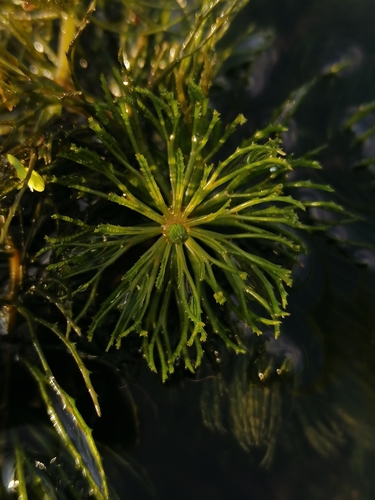
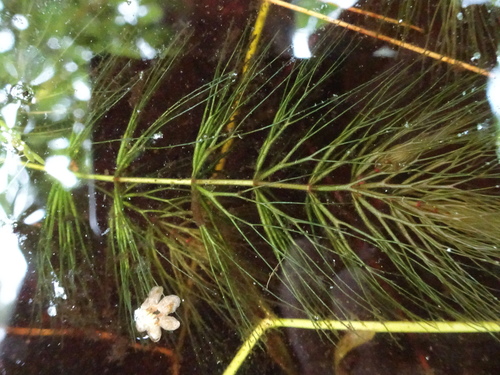
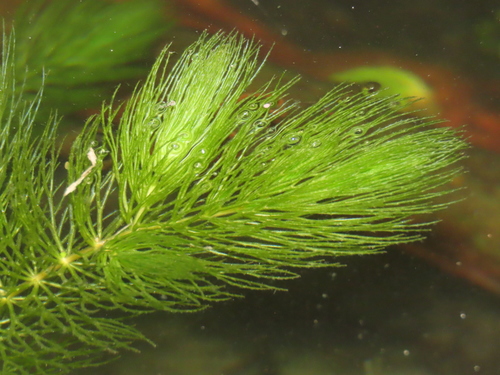
Ceratophyllum demersum L. is an aquatic plant. Its stems grow 1–3 meters (3–10 feet) long, and numerous side shoots give individual plants a large, bushy appearance. Leaves grow in whorls of 6 to 12; each leaf is 8–40 mm long, stiff and brittle, and either simple or forked into 2 to 8 thread-like segments edged with spiny teeth. This species is monoecious, meaning separate male and female flowers grow on the same plant. The small 2 mm long flowers form in leaf axils, and have 8 or more greenish-brown petals. The fruit is a small 4–5 mm long nut, usually bearing three 1–12 mm long spines: two at the base and one at the apex. Plants with very short basal nut spines are sometimes classified as Ceratophyllum demersum var. apiculatum (Cham.) Asch., while plants with no basal spines are sometimes classified as Ceratophyllum demersum var. inerme Gay ex Radcl.-Sm. This species can produce winter-dormant buds called turions, which sink to the bottom of the water body over winter and grow into new plants in spring. Rigid hornwort can easily be confused with soft hornwort (Ceratophyllum submersum), especially when it has young growth with less stiff leaves. A key distinguishing feature is how many times leaves branch: leaves of Ceratophyllum demersum only fork once or twice, while soft hornwort leaves fork three to four times. The leaves of rigid hornwort also have coarser, more prominent teeth than those of soft hornwort. Ceratophyllum demersum grows in lakes, ponds, and quiet streams with summer water temperatures between 15–30 °C and nutrient-rich conditions. It requires still or very slow-moving water. In North America, it is found across the entire United States and Canada, with the exception of Newfoundland. In Europe, it has been recorded as far north as 66 degrees latitude in Norway. Other confirmed locations where it occurs include China, Siberia (at 66 degrees North), Burkina Faso, the Volta River in Ghana (Africa), Vietnam, and introduced populations in New Zealand. C. demersum has allelopathic properties: it excretes substances that inhibit the growth of phytoplankton and cyanobacteria (blue-green algae). Dense stands of C. demersum can outcompete other native underwater vegetation, leading to reduced biodiversity. In New Zealand, this species has caused operational problems for hydroelectric power plants. This species is commonly used as a floating freshwater plant in both coldwater and tropical aquaria. Although it has no roots, it can attach to aquarium substrates or objects inside the aquarium. Its fluffy, filamentous bright-green leaves provide excellent shelter for newly hatched fish. It is propagated by cuttings. When exposed to snail-killing chemical products, this plant sheds all its leaves, but stems can recover relatively quickly, growing new leaves within a few weeks. It is frequently used as a model organism for plant physiology research. A major advantage of this use is that researchers can study shoot effects without any influence from a root system, which often complicates interpretation of nutrition and toxicity experiments in terrestrial plants. Since it is free-floating and does not need a solid substrate, it has been used successfully in the biological life support systems Aquarack/CEBAS and Omegahab on space flights. Hornwort plants, or the epiphytes they support, have been demonstrated to degrade the herbicide atrazine.