About Ceratophaga vastellus (Zeller, 1852)
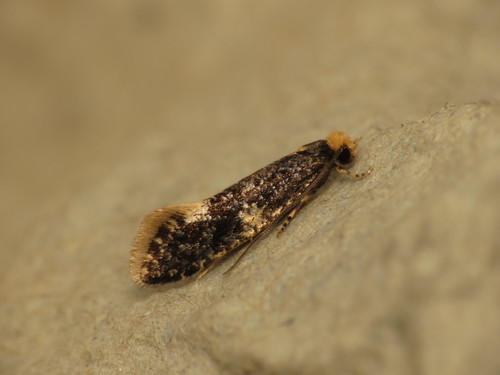
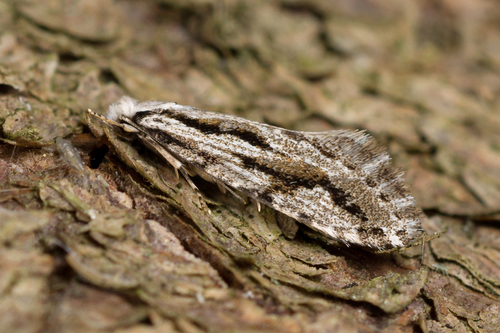
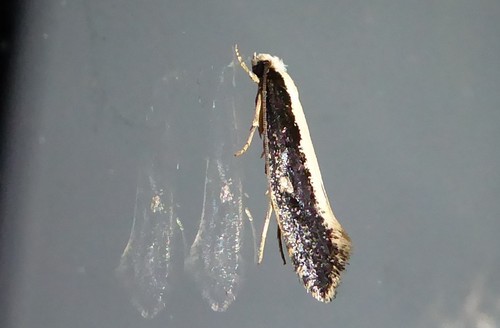
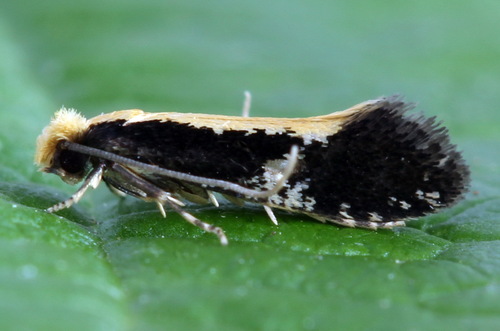
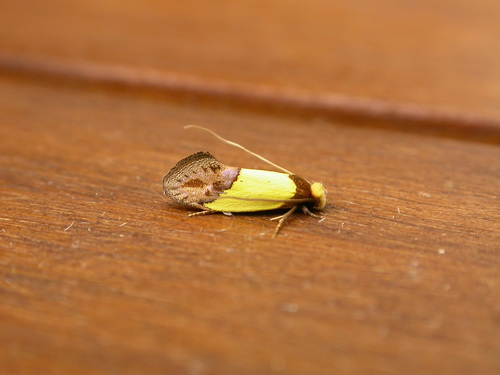
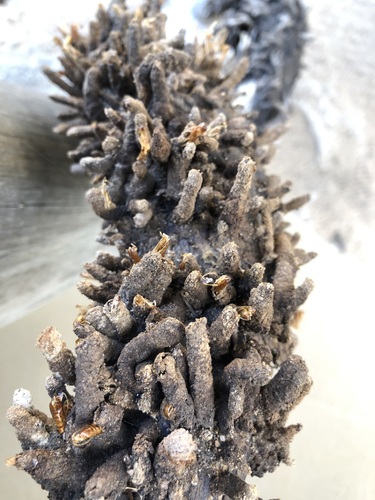
Ceratophaga vastellus (Zeller, 1852), commonly called the horn moth, belongs to the clothes moth family Tineidae. It is best known for its larvae’s ability to feed on keratin from the horns and hooves of dead ungulates; larvae occasionally also feed on dried fruit or mushrooms. Keratin is the protein that forms skin, hair, nails and feathers, and it is extremely resistant to breakdown by proteolytic enzymes from specialized microorganisms like fungi and bacteria. This species is widespread across the Afrotropical realm. The genus Ceratophaga currently contains 16 described species: 12 are found in Africa, three in Asia, and one (C. vicinella) in the Americas. C. vicinella feeds on the shells of the gopher tortoise Gopherus polyphemus, a species native to the southeastern United States, and also feeds on cattle horns in the US. Horn moth larvae are thick-set and cream-coloured, with a brown head and a brown abdomen tip. Larval cases are most often observed on the surface of old horns. The adult horn moth is a typical tineid moth, with a noticeable conspicuous tuft of yellow hair on its head. Other species in the Tineidae family share C. vastellus’s diet of keratin, dried animal hides, and wool, including C. ethadopa (Meyr.), Monopis rejectella (Wlk.), Tinea pellionella and Tineola bisselliella. Entomologist Thomas de Grey (1843–1919) proposed that larvae of this species may occasionally be found living inside the horns of living animals. This idea was discussed after two pairs of antelope horns were exhibited to a meeting by J. M. Neligan, M.D., with additional remarks from Mr. Haliday. One pair of these horns belonged to Oreas canna, and the other to Kobus ellipsiprymnus. They were brought back to Europe from the Gambia by J. Fitzgibbon, Esq., M.D., who purchased the horns from local people at a market on Macarthy's Island. Fitzgibbon noted the unusual appearance of the horns: they were riddled with perforations from grubs, whose cases projected abundantly from the horn surface. This was notable because the horns were taken from freshly killed animals, whose blood had not yet dried when they reached the market. This observation provided evidence that the horns had been infested while the animals were still alive. Since the fibrous structure of horn changes very little after an animal dies, there appears to be no reason an adult moth could not lay eggs on the horn while the animal is resting, and that larvae could then penetrate the horn. Even so, the question of whether C. vastellus can infest living animal horns remains undecided. Zeller and Roland Trimen both expressed doubt that larvae feed on the horns of living animals, and their view was supported by Lieutenant Colonel the Hon. Wenman Coke, a soldier and hunter. Thomas de Grey also documented a pair of Kobus ellipsiprymnus horns in his personal collection that were bored by C. vastellus larvae, with the horn substance visibly perforated in multiple places up to one-fourth of the way from the base. This observation clearly suggests that larvae do not restrict themselves to feeding on keratin, and will also burrow into the bony portion of the horn.