About Ceratonia siliqua L.
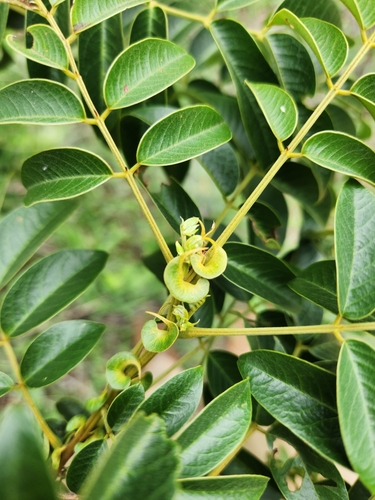
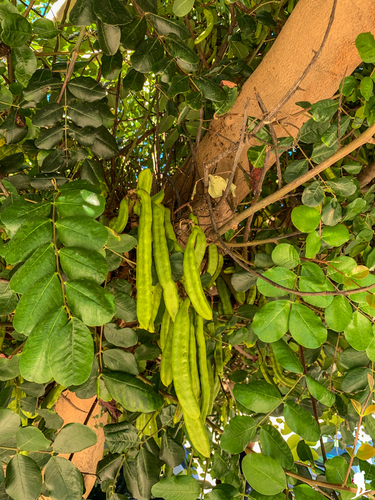
Ceratonia siliqua L., commonly called the carob tree, grows up to 15 metres (50 feet) tall. It has a broad semispherical crown, supported by a thick trunk with rough brown bark and sturdy branches. Its leaves are 10 to 20 centimetres (4 to 8 inches) long, alternate, pinnate, and may or may not have a terminal leaflet. It tolerates frost down to approximately −7 °C (19 °F). Most carob trees are dioecious, meaning strictly male trees do not produce fruit, but some trees are hermaphroditic. Carob trees blossom in autumn; their flowers are small and numerous, arranged spirally along the inflorescence axis in catkin-like racemes. These racemes grow on spurs from old wood, and even directly on the trunk, a trait called cauliflory. Flowers are pollinated by both wind and insects. Male flowers have an odor similar to human semen, caused in part by amines. The fruit is a legume, commonly but less accurately called a pod. It is elongated, compressed, and either straight or curved, with thickened sutures. Pods take a full year to develop and ripen. When sweet, ripe pods fall to the ground, they are eaten by various mammals such as swine, which disperse the hard inner seeds through their excrement. Carob tree seeds contain leucodelphinidin, a colourless flavanol precursor related to leucoanthocyanidins.
The carob tree is native to the Mediterranean region and the Middle East. While extensively cultivated, it still grows wild in eastern Mediterranean regions, and has become naturalized in the western Mediterranean. It is a common native species in the southern Portuguese region of Algarve, where it is called alfarrobeira, and its fruit is called alfarroba. It is also found in southern and eastern Spain (called algarrobo/algarroba in Spanish, and garrofer, garrofera, garrover, garrovera in Catalan/Valencian/Balearic), mainly in Andalusia, Murcia, Valencia, the Balearic Islands and Catalonia; in Malta it is called ħarruba in Maltese; it grows on the Italian islands of Sicily (Sicilian: carrua) and Sardinia (Sardinian: carrubba, carruba); in Southern Croatia (Croatian: rogač), including the island of Šipan; in eastern Bulgaria (Bulgarian: рожков); in Southern Greece, Cyprus, and on many Greek islands such as Crete and Samos. In Israel, its Hebrew name is חרוב, transliterated as kharúv. Its common Greek name is χαρουπιά, transliterated charoupiá, or ξυλοκερατιά, transliterated xylokeratiá, which means "wooden horn". In Turkey, it is called keçiboynuzu, which translates to "goat's horn". Note that the various trees called algarrobo in Latin America (Samanea saman in Cuba, Prosopis pallida in Peru, and four Prosopis species in Argentina and Paraguay) belong to a different Fabaceae subfamily: Mimosoideae. Early Spanish settlers named them algarrobo after the carob tree because they also produce pods with sweet pulp.
The genus Ceratonia belongs to the legume family Fabaceae, and is thought to be an archaic remnant of a now largely extinct branch of this family. Carob trees grow well in warm temperate and subtropical areas, and tolerate hot, humid coastal areas. As a drought-resistant xerophyte, it is well adapted to Mediterranean conditions, thriving with just 250 to 500 millimetres (10 to 20 inches) of rainfall per year. Carob trees can survive long drought periods, but require 500 to 550 millimetres (20 to 22 inches) of annual rainfall to produce fruit. They prefer well-drained sandy loams and are intolerant of waterlogging, but their deep root systems can adapt to a wide range of soil conditions, and they are fairly salt-tolerant, able to grow in soils with up to 3% salt. After being irrigated with saline water in summer, carob trees may be able to recover during winter rainfalls. Experiments have shown that young carob trees can maintain basic physiological functions in high-salt conditions of 40 mmol NaCl/L.
Not all legume species can form a symbiotic relationship with rhizobia to use atmospheric nitrogen. It remains unclear whether carob trees have this ability: some findings suggest they cannot form root nodules with rhizobia, while a more recent study identified carob trees with nodules containing bacteria thought to be from the genus Rhizobium. However, a study measuring the 15N isotopic signature in carob tree tissue did not support the theory that carob trees naturally use atmospheric nitrogen.
Natural vegetative propagation of carob is limited by its low adventitious rooting potential. For this reason, grafting and air-layering are often more effective methods of asexual propagation. Seeds are the most commonly used propagation medium. Sowing takes place in pot nurseries in early spring; the cooling- and drying-sensitive seedlings are transplanted to the field the following year, after the last frost. Carob trees enter their production phase slowly. In areas with favorable growing conditions, cropping begins 3–4 years after budding, while the nonbearing period can last up to 8 years in regions with marginal soils. Full bearing, with stabilized yield, mostly occurs when trees reach 20–25 years of age. Carob orchards are traditionally planted at low densities of 25–45 trees per hectare (10 to 20 trees per acre). Hermaphroditic or male trees, which produce fewer or no pods respectively, are usually planted at lower densities as pollenizers. Intercropping with other tree species is widely practiced. Little cultivation management is required: only light pruning and occasional tilling to reduce weeds is necessary. Nitrogen fertilization has been shown to have positive effects on carob yield. Though carob is native to a moderately dry climate, two or three irrigations during summer greatly aid tree development, speed up fruiting, and increase yield.
Human-consumed carob products come from the dried, sometimes roasted, pod, which has two main parts by weight: 90% pulp and 10% seeds. Carob pulp is sold as either flour or chunks. Flour made from the carob seed (embryo) can also be used for human and animal nutrition, but seeds are often separated before carob powder is produced. Carob pods are mildly sweet on their own, with sugar making up roughly one third to one half of their dry weight. They are used in powdered, chip or syrup form as an ingredient in cakes and cookies, and are sometimes used as a substitute for chocolate in recipes due to their color, texture, and taste. In Malta, a traditional sweet called karamelli tal-harrub, eaten during the Christian holidays of Lent and Good Friday, is made from carob pods. Dried carob fruit is traditionally eaten on the Jewish holiday of Tu Bishvat. Carob pods were used as famine food in the Mediterranean Basin, including the southern Atlantic coast of Portugal and the Atlantic northwestern Moroccan coast.
In rabbinic literature, carob was considered a low-status food. One source advises that even a single kab of carobs should not be hoarded during times of scarcity. Other rabbinic texts note that carob is suitable for animal feed.