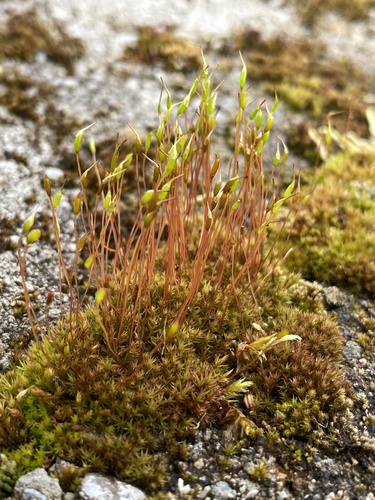
About Ceratodon purpureus (Hedw.) Brid.
Ceratodon purpureus, commonly called fire moss, is a short moss that forms dense tufts, and occasionally forms cushions. Its stems are erect, and usually grow to around 0.5 inch (1.3 cm) long. The upper 0.19 inch (0.5 cm) of the stem consists of current year's growth; stems are often slightly branched via forking at the tip of older growth. In shaded locations, stems can sometimes reach 2.4 to 3.1 inches (7–8 cm) long. Its leaves are short and hairlike, spreading when the moss is moist, and somewhat folded or twisted when it is dry. Fire moss produces photoprotective pigments, an adaptation that works well for the bright conditions of the Antarctic environment. Leaf pigment in this species ranges from green to ginger. In terms of distribution and habitat, fire moss likely grows in every country, though it may be replaced by closely related taxa in tropical latitudes. It is widespread across Canada, growing in every Canadian province and territory, and it also occurs in every US state. Fire moss tolerates much higher pollution levels than many other mosses. It is common in polluted urban and industrial environments, along highways, and on mining tailings and refuse from both coal and heavy-metal mining. It is frequently found on disturbed sites, and grows on a wide range of substrates including soil, rock, wood, humus, old roofs, sand, and sidewalk cracks. It is most abundant on exposed, compact, mineral, dry, gravelly or sandy soils, but tolerates a broad range of soil textures. In Scotland, fire moss colonizes sand dunes close to water, growing between grass shoots. Fire moss is dioecious. It reproduces generatively via spores, and vegetatively via protonemata. Its spore capsules are held horizontally at the end of a long seta, or fruit stalk. Fire moss generally produces abundant fruit. Wind is the primary method of spore dispersal. Spore germination in fire moss follows a two-phase process: spores first swell, then distend. Setae are usually very numerous in a fire moss colony; they twist and untwist with changes in humidity. This movement jerks the capsules, which helps discharge spores. It is possible that contraction of grooves in the mature capsule also helps squeeze spores out. Fire moss spores can remain viable even after being dried for 16 years. Fire moss's sporophytes emerge early in the spring, as soon as snow melts. In March, setae reach their full height and begin turning from green to red. Capsules finish maturing by late spring. By midsummer, capsules often decay, and setae break away from the main moss. In terms of ecology, fire moss prefers sites with low competition and high light, though it is somewhat tolerant of shade; for example, it has been recorded growing in artificially illuminated caves. It is a pioneer species that colonizes disturbed sites, and easily invades mineral soil via spores. It is typically found growing alongside other species characteristic of disturbed sites, such as fireweed (Epilobium angustifolium) and pearly everlasting (Anaphalis margaritacea). In later stages of ecological succession, fire moss is often outcompeted and replaced by flowering plants. In the black spruce (Picea mariana)-lichen woodlands of Alaska and Canada, the first 1 to 20 year stage of revegetation is dominated by pioneer mosses including fire moss. Fire moss biomass continues to increase in the early part of the shrub succession stage, but begins to decline toward the end of this stage. Fire moss colonizes recently burned areas using lightweight, wind-dispersed spores that come from off-site. High-severity fires expose mineral soil, creating ideal conditions for fire moss spore germination. Fire moss is often the dominant vegetation for several years after a high-severity fire. It produces few spores in the first year after a fire, and many spores in the second year. If a fire occurs in early spring, gametophores can develop in 4 to 5 months. If a fire occurs in the fall, colonization proceeds more slowly.

