About Ceratocapnos claviculata (L.) Lidén
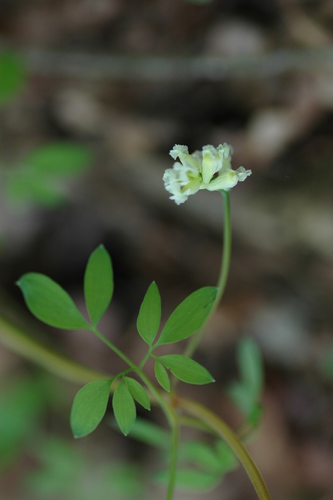
Ceratocapnos claviculata (L.) Lidén, commonly called climbing corydalis, is a generally hairless plant that looks delicate. It usually grows as an annual, though it may occasionally grow as a perennial, reaching up to one metre in height. It has weak, often pinkish, clambering stems. Its leaves are pale to medium green and doubly compound; individual leaflets have distinct stalks, are split into three to five subleaflets, and end in a branching tendril. In the United Kingdom, this plant blooms between May and September. Its flowers are small, measuring roughly 6 mm (0.24 in) long, and are pale creamy-yellow. They grow in short axillary spikes. Each flower is elongated and tubular, with a lip, a spur, and stamens grouped into two bundles. Its seed pods are short, and typically narrow between the two seeds they contain. This species occurs across several countries in western Europe: Belgium, Denmark, France, Germany, Ireland, the Netherlands, Spain, Portugal and Norway. The largest share of its global population is located in the United Kingdom. In Britain, it grows across most counties, particularly in more western areas. It is not found in Orkney, Shetland or the Outer Hebrides, and it is rare in Ireland. As of 2005, its United Kingdom conservation status is least concern. Climbing corydalis most often grows on the edges of woodlands and sites that were previously wooded. It prefers acid soils that are either sandy or peaty, and typically grows in sheltered, half-shaded positions. It is sometimes abundant in disturbed areas of recently cleared plantations or woods, where it clambers over wood debris. It grows successfully in impoverished soil under bracken, likely because it flowers early in the year before bracken fronds fully develop. It is a food plant for the weevil Procas granulicollis and the beetle Sirocalodes mixtus. Honey bees and bumblebees act as its pollinators.