About Ceratina calcarata Robertson, 1900
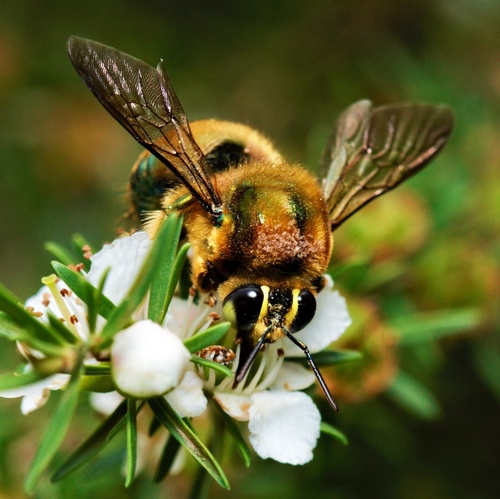
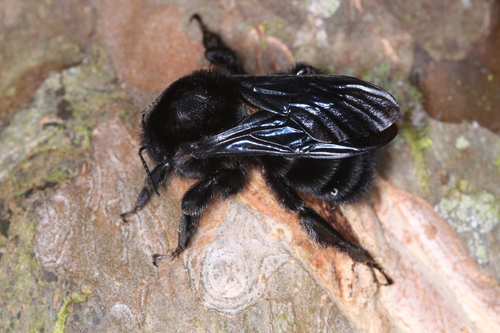
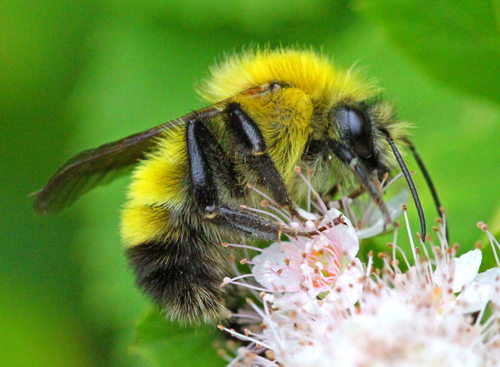
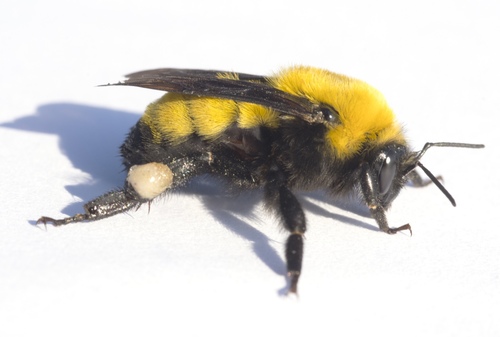
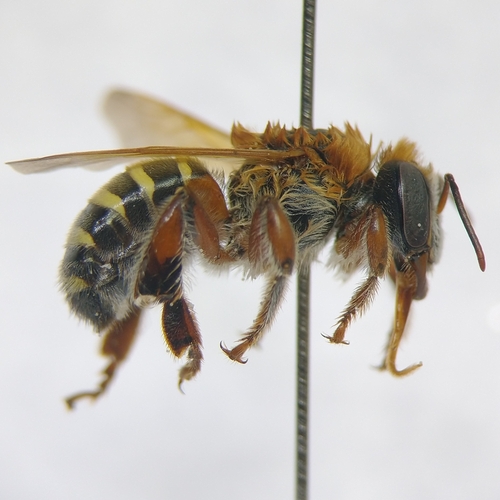
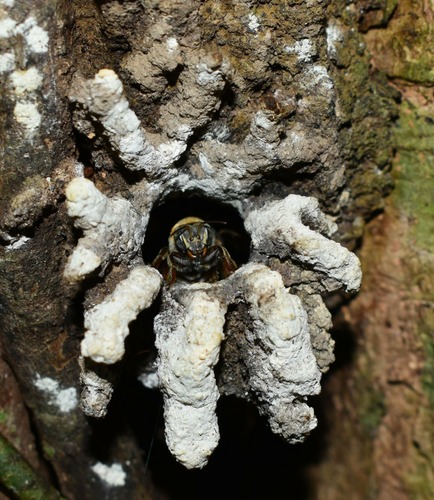
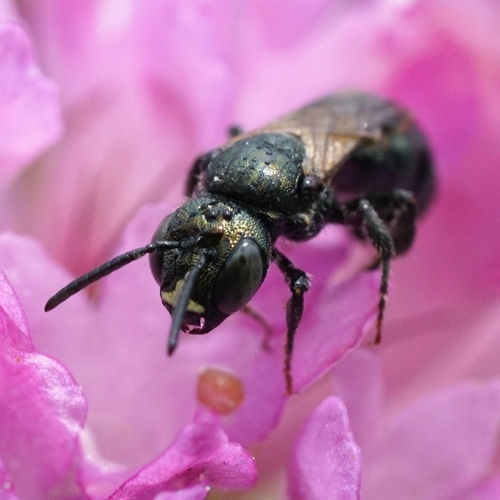
Ceratina calcarata, commonly known as the spurred ceratina, is a species of small carpenter bee belonging to the family Apidae. It is native to eastern North America, with a range extending from Georgia, USA north to Ontario, Canada, and east to Nova Scotia, Canada. This bee is a common native generalist pollinator, and it pollinates crops like watermelon and cucumber very effectively. Due to its broad range and local abundance, C. calcarata contributes to the productivity of a wide variety of both ecological and agricultural systems. This small bee has emerged as a model organism for scientific research into social evolution. It is the first subsocial bee species to have its full genome published, which enables researchers to study the evolutionary origins of social behavior. For reproduction, male eggs are laid on smaller provision masses than the provision masses that female eggs are laid on. There is a positive association between the size of a mother C. calcarata and her foraging capabilities, but contrary to common expectation, larger mothers do not produce more daughters. Larger offspring are more beneficial for this species because larger progeny are more likely to survive winter months. This leads to an indirect increase in fecundity, as more winter-surviving bees can reproduce, increasing the potential number of grand-offspring. Cuticle hydrocarbons act as signals for reproductive status and age in C. calcarata, and the hydrocarbon pentacosane functions as the fertility signal. Researchers believe these reproductive signals are the evolutionary precursors to queen pheromones seen in eusocial insects. In most eusocial insects, queens use pheromones to suppress reproduction by daughter worker bees. However, in the subsocial C. calcarata, pre-dispersal females have fully developed ovaries and can lay eggs, but they do not have the opportunity to become fertilized. They will soon enter diapause and have no chance to produce offspring in the current season, so overexpression of pentacosane by the mother queen is not required to regulate and suppress offspring reproduction. It has also been hypothesized that this bee uses chemical profiles to distinguish between different individuals, meaning other C. calcarata can tell individual nest members apart from non-nest members based on the chemicals an individual emits.