About Cerastoderma edule (Linnaeus, 1758)
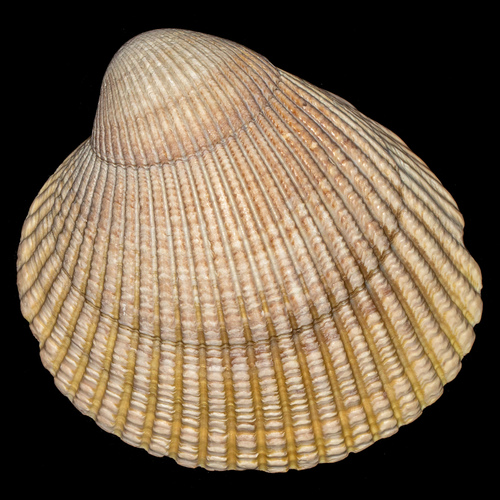
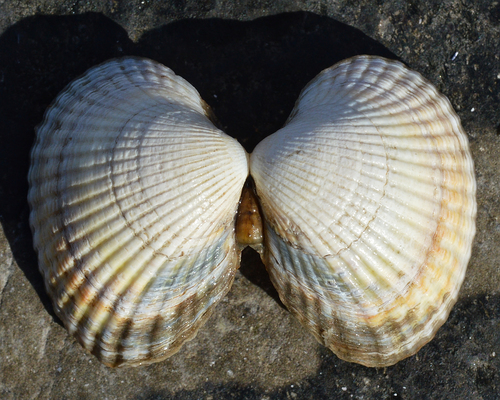
Cerastoderma edule, first described by Linnaeus in 1758, typically grows 3.5 centimetres (1.4 in) to 5 centimetres (2.0 in) long, and may occasionally reach 6 centimetres (2.4 in). Its shell is oval in shape, pale yellow, whitish yellow, grubby white, or brown in color, and covered in ribs that are flattened across the middle section of the shell. The species' digestive glands range from light brown to dark green. This distinguishes it from the similar lagoon cockle, which has an elongated posterior shell, black digestive glands, and lives in stagnant water substrate. This species occurs in coastal areas of the northern and eastern Atlantic Ocean, with a wide distribution ranging from Iceland and Norway in Europe south to Senegal along the West African coast. It is one of the most abundant mollusc species on tidal flats in European bays and estuaries, and serves as a major food source for crustaceans, fish, and wading birds. C. edule is a filter feeder that obtains food by straining suspended matter and food particles from water; water is drawn in through an inhalant siphon and expelled through an exhalant siphon. It is both euryhaline (tolerates a wide range of salinity) and eurythermic (tolerates a wide range of temperatures), a trait that contributes to its very large geographic range. It has two annual spawning periods: one in early summer and a second in autumn. C. edule was likely an important food source for prehistoric European hunter-gatherer societies, and prehistoric clay bearing shell imprints of this species has been found. The imprinted clay features fine decorative patterns made from the distinct curved ridges, undulating lines, and edges characteristic of this cockle's shell, a abundant natural resource from coastal waters. Today, this cockle is harvested and eaten in the United Kingdom, France, Germany, Ireland, Japan, Portugal, Spain, and other regions. It is most often cooked, but is also sometimes served pickled or raw. In addition to using its meat as food, the shells have been used industrially as a source of lime. C. edule is an economically important species for the fishing industry, and is commercially fished in the United Kingdom, Ireland, and France via suction dredge and hand raking. Historically, the Netherlands produced the largest catches, but fishing restrictions have been put in place there due to environmental concerns. Similar restrictions have been implemented in other locations: Scotland prohibits vehicle-based dredging, and parts of England and Wales only allow traditional hand-gathering done with a long plank rocked back and forth on the sand. In 2004, an incoming tide at Morecambe Bay in England killed 23 cockle-gatherers harvesting this species. This species is also farmed via aquaculture in the United Kingdom, the Netherlands, and Portugal, though production has not been stable: for example, total production fell from 107,800 tons in 1987 to 40,900 tons in 1997.