About Cerastes cerastes Linnaeus, 1758
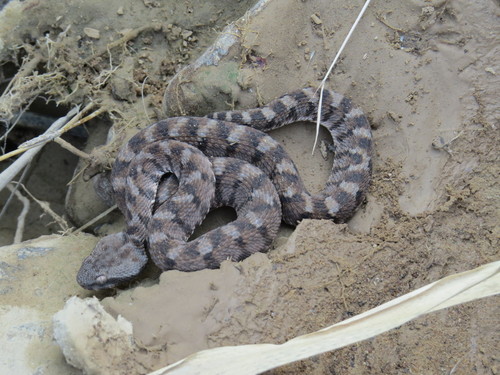
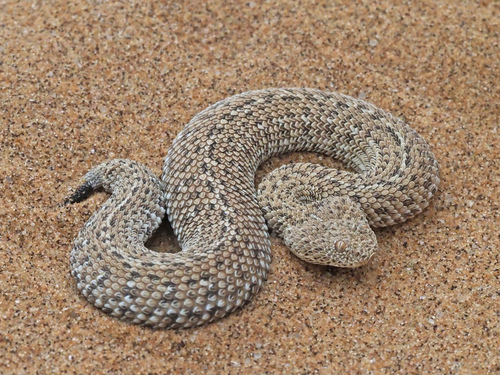
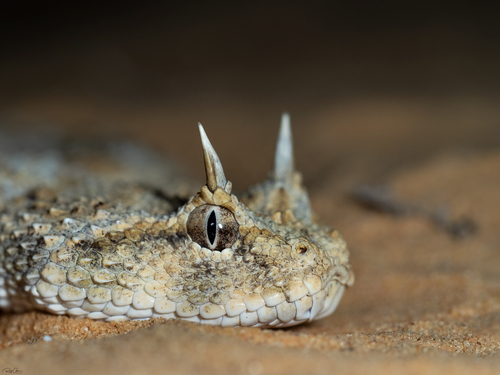
Cerastes cerastes Linnaeus, 1758, commonly known as the desert horned viper, has an average total body and tail length of 30–60 cm (12–24 in), with a maximum recorded total length of 85 cm (33 in). Females of this species are larger than males overall, while males show distinct sexual dimorphism by having larger heads and larger eyes than females. One of the species' most recognizable features is a pair of supraorbital "horns", with one located above each eye. These horns can sometimes be reduced in size or completely absent, as noted in the genus Cerastes. Its eyes are prominent and positioned on the sides of the head. Compared to the related species Cerastes gasperettii, C. cerastes has a larger relative head size, and a higher frequency of individuals that have the characteristic supraorbital horns: 48% for C. cerastes versus 13% for C. gasperettii. The species' base body color ranges from yellowish, pale grey, pinkish, reddish to pale brown, and this base color almost always matches the color of the local substrate where individual snakes are found. Along the dorsal side of the body, a series of dark, semi-rectangular blotches runs the full length of the body; these blotches may be fused into crossbars or remain separate. The belly is white, and the usually thin tail may have a black tip. This snake is common in Iraq, and is also found across Syria, Saudi Arabia, Palestine, Yemen, Jordan, Israel, Qatar, Mauritania, Morocco and Kuwait, as well as parts of North Africa including Libya, Egypt, and Sudan. The original type locality was only listed as "Oriente", but Flower (1933) clarified this to "Egypt". C. cerastes favors dry, sandy areas with sparse rock outcroppings, and generally avoids coarse sand. Individuals are occasionally found around oases, and the species occurs at altitudes up to 1,500 metres (4,900 ft). It prefers cooler areas, with annual average temperatures of 20 °C (68 °F) or lower. In captive individuals, mating has been observed in April, and always takes place while the snakes are buried in sand. This species is oviparous, laying clutches of 8 to 23 eggs that hatch after 50 to 80 days of incubation. Eggs are laid under rocks and in abandoned rodent burrows. Newly hatched juveniles have a total length of 12–15 cm (about 5–6 inches).