About Cerapteryx graminis Linnaeus, 1758
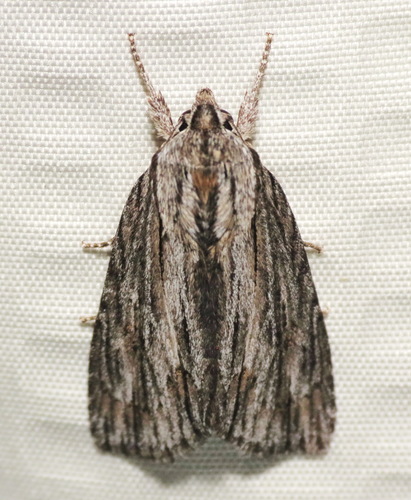
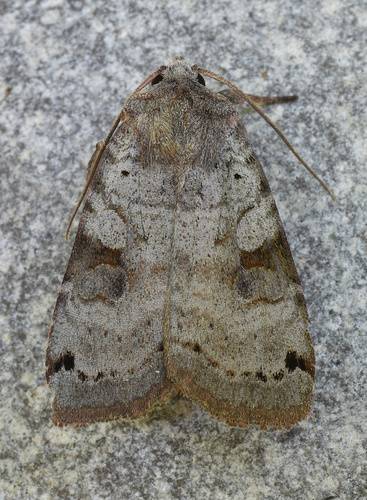
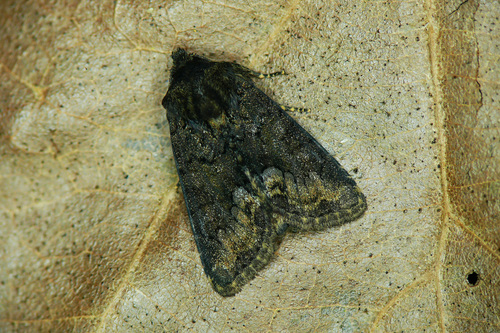
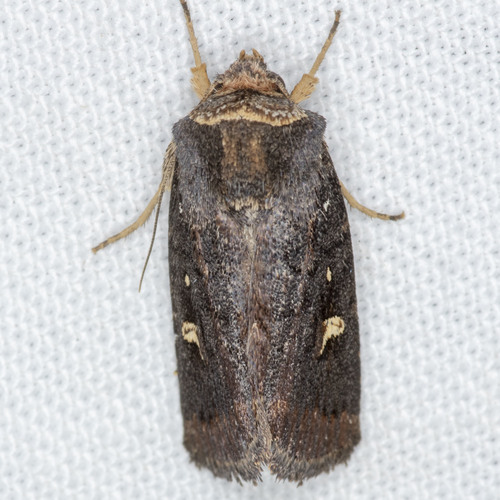
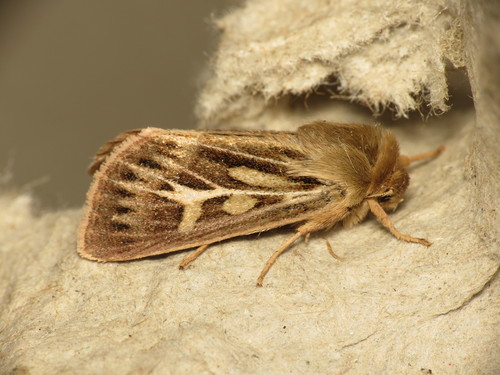
This species, Cerapteryx graminis, displays unusual marked sexual dimorphism for a noctuid moth. Males have a wingspan of 27–32 mm, while females are much larger, with a wingspan of 35–39 mm. Its forewings are brown, speckled with black, and marked with a distinct white branched basal streak that gives the species its common name. The hindwings are dark brown with a white fringe. In technical terms, the forewing can be olive grey, olive rufous, or olive fuscous; the median and marginal areas are sometimes deeper in colour, and the three transverse lines are otherwise undefined. The stigmata are pale, especially the reniform stigma, which is white at its base, extending a pale ray towards the wing base along the median vein, and two rays outwards along veins 3 and 4. The claviform stigma is elongated, and the orbicular stigma is flattened. The hindwing is dark fuscous grey, with a pale, sometimes whitish basal area, and a white fringe. Several named forms have been described: in the male form tricuspis Esp., the trifid lower end of the reniform stigma is more strongly developed than usual; obsoleta Tutt is an extreme form of tricuspis where all other markings are absent; rufocosta Tutt, a form from the Hebrides, is a grey morph with a red costal streak; in hibernicus Curt., the base of the forewing cell bears a pale, elongated, sometimes forked patch; in albipuncta Sven., the white lower end of the reniform is entire, with no pale branching; gramineus Haw. has all veins pale whitish, with dark olive interspaces that contain no rufous tint, and more conspicuous pale stigmata and cell base. In this form, the submarginal line is prominently pale and toothed along the veins, with its teeth alternating with dark teeth from the marginal area. This form is more common in northern Britain, and pallida Tutt is an extreme development of it, where the pale claviform stigma, median vein, and two upper stigmata merge to form a broad white band extending from the wing base; grisea Spul., from northern Germany, is a grey form with a well-defined median area, and may only be a variant of graminis that is not well-known on the European continent. This moth often flies during the day, particularly in warm weather, and is attracted to many different flowers. It also flies at night and is attracted to light. Adults are active on the wing from July to September. In the life cycle, young larvae are greenish, and change colour to grey-brown to brown as they age. Mature larvae have a stout, roller-shaped body, with pale longitudinal lines and black spiracles. Their underside and legs are light brown, and the head is shiny brownish. Larvae feed on various grasses including Deschampsia, Festuca and Nardus. The species is sometimes abundant enough to damage pastures. It overwinters in the egg stage.