About Cepphus grylle (Linnaeus, 1758)
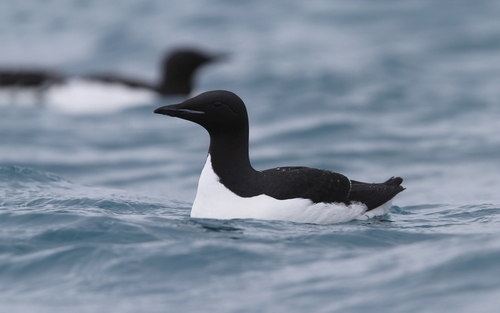
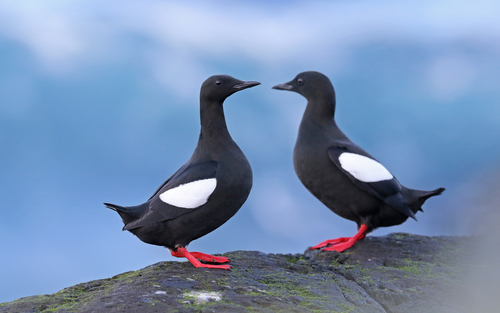
The black guillemot, scientific name Cepphus grylle (Linnaeus, 1758), is a medium-sized seabird. Adult individuals are typically 30 to 38 centimeters (12 to 12+1⁄2 inches) long, with a wingspan ranging from 52 to 58 cm (20+1⁄2 to 23 in), and a body weight between 300 to 460 grams (10+1⁄2 to 16 ounces). Adults have distinct summer and winter plumage, and no sex-based plumage difference can be identified in the field. Its English common name comes from its striking all-black breeding summer plumage, which only differs by a large white patch on the upper side of the wings. In summer plumage, the legs, feet, and inside of the mouth are bright coral-red, and the beak is black. Adults molt their summer plumage in early fall. After molting, their upper plumage becomes barred light grey and white, their head is pale grey, their underparts are white, and their legs and feet turn pale red. They keep their white wing patch, black beak, and red mouth interior year-round. During the breeding season, the black guillemot produces a high whistle call, and its red gape is also prominent at this time. Juvenile and immature black guillemots can be easily identified even from a distance in the field by grey or brown feather spotting on their white wing patch.
This is a circumpolar species distributed across boreal, low arctic, and high arctic regions of the North Atlantic and Arctic Oceans, and breeds between 43° and 82°N. Five recognized subspecies occupy different sections of this overall range. In North America, it ranges as far south as the Gulf of Maine and New England, and extends along the northern coast of North America all the way to Alaska, where it is replaced by the pigeon guillemot in the North Pacific. In Europe and Asia, it occurs from the British Isles northward across the northern coast of Asia. It is one of the few bird species that breeds on Surtsey, Iceland, a recently formed volcanic island. It is a fairly common breeding bird along the coast of Ireland, and in western and northern Scotland. In the rest of Britain, it only breeds at St. Bees Head in Cumbria, the Isle of Man, and on east Anglesey in north Wales. Around 40% of the global population breeds in the high arctic, where the largest colonies are located, 30% breeds in the low arctic, and 30% breeds in boreal waters. In winter, high arctic populations are forced south by winter ice, making them seasonal migrants, while populations in more temperate zones are essentially non-migratory residents. Black guillemots are typically restricted to rocky shores; they use cliffs, crevices, and boulders for nesting, and hunt benthic prey in inshore waters. Compared to other auks, they forage fairly close to their breeding colony: during the breeding season, they mostly forage in inshore waters less than 50 meters deep, and travel farther from shore in the winter months.