About Cepphus columba Pallas, 1811
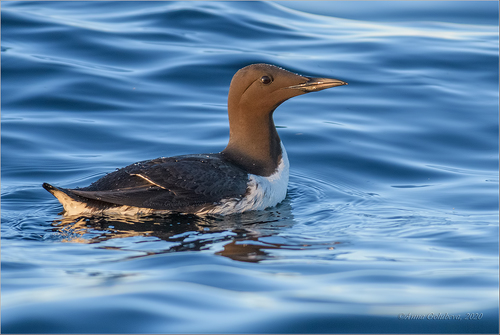
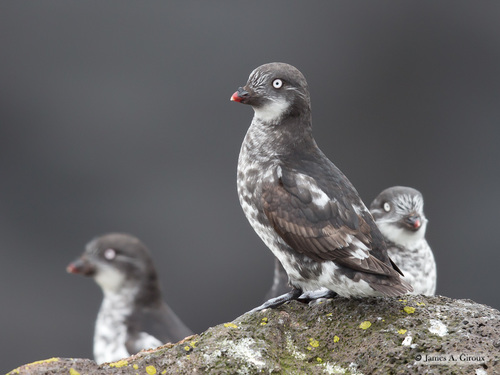
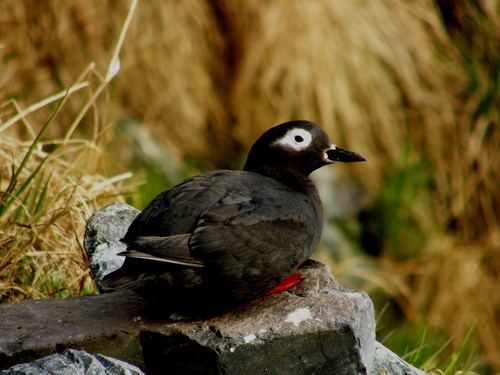
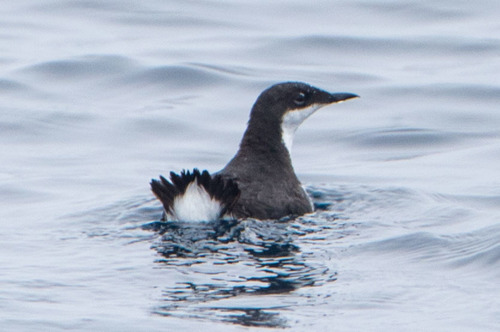
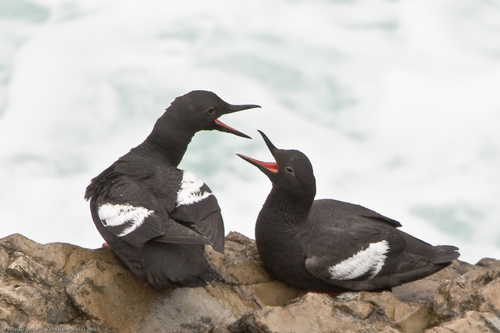
The pigeon guillemot (scientific name Cepphus columba Pallas, 1811) is a medium-sized auk, measuring 30 to 37 cm (12 to 15 in) in length and weighing 450 to 550 g (16 to 19 oz). Both sexes have similar appearance and body mass, with the exception of Californian pigeon guillemots, where females have larger bills than males. Adult summer (breeding) plumage is mostly dark brown with a black sheen, and features a white wing patch divided by a brown-black wedge. In winter, the upperparts are iridescent black, often marked with black fringes that create a scalloped appearance, while the underparts and rump are white. The forehead, crown, lores, eye line, and ear coverts are black with white tips; when the tips are narrow, the head appears solid black. The underwings are plain and dark across all plumages. Adults moult into winter (non-breeding) plumage between August and October. The moult takes roughly one month to complete, and during this period the bird cannot fly for around four weeks. Moulting into breeding plumage occurs between January and March. The pigeon guillemot has red legs and feet with black claws, a brown iris, and a thin unbroken white ring surrounding the eye. Its bill is long and black, and the inside of the mouth is red. Juvenile pigeon guillemots resemble winter adults, but have brown-tipped underpart feathers that create a barred appearance, more brown feathers on the upperparts, and a smaller wing patch. Juvenile legs are grey-brown. Juveniles lose their brown underpart feathers after their first moult, which occurs two to three months after fledging. Their moult into first summer plumage happens later than adult moult, between March and May, and first summer birds do not have the glossy sheen of adult birds. Differences between subspecies are based on body measurements including culmen and wing length: southern subspecies are larger, while subspecies further north are smaller. The amount of white on the outer primaries and underwing coverts increases in northern subspecies, the only exception being Cepphus columba snowi, where white markings are reduced or entirely absent. The pigeon guillemot walks well and typically holds an upright posture. When sitting, it often rests on its tarsi. Compared to other auks, the pigeon guillemot has shorter, rounder wings, which reflects its greater adaptation for diving rather than flying. It struggles to take off in calm conditions without a runway, but once airborne it is faster than the black guillemot, with recorded speeds of 77 km/h (48 mph), roughly 20 km/h (12 mph) faster than the black guillemot. On the water surface, it is a strong swimmer that propels itself with its feet. When diving, it uses both its wings, which beat at a rate of 2.1 beats per second, and unusually for auks, also its feet for propulsion. Pigeon guillemots have been recorded travelling 75 m (246 ft) horizontally during dives. It is similar to the closely related black guillemot, but can be told apart by its larger size, and in the breeding season by its dusky-grey underwing and the dark brown wedge on its white wing patch. The pigeon guillemot’s range spans the Northern Pacific, from the Kuril Islands and Kamchatka Peninsula in Siberia to western North American coasts from Alaska to California. Its wintering range is more restricted than its breeding range; pigeon guillemots usually winter at sea or along coasts, from the Pribilof and Aleutian Islands to Hokkaido and southern California. In Alaska, some individuals migrate south due to advancing sea ice, while others remain in ice leads or ice holes some distance from the edge of the ice sheet. Further south, birds banded on the Farallon Islands in central California have been recorded moving north, as far as Oregon and even British Columbia. The species is generally philopatric, meaning individuals return to the colony where they hatched to breed, but they sometimes move long distances after fledging before settling; for example, a chick ringed in the Farallon Islands was later recorded breeding in British Columbia. Breeding habitats for this bird are rocky shores, cliffs, and islands located near shallow water less than 50 m (160 ft) deep. It is flexible regarding the exact location of its breeding site, with protection from predators being the most important factor. It breeds more commonly on offshore islands than on coastal sea cliffs. In winter, it forages along rocky coasts, often in sheltered coves. It avoids water with sandy bottoms, presumably because this habitat does not support its preferred food. It can occasionally be found further offshore, as far out as the continental shelf break. In the Bering Sea and Alaska, it feeds in openings within ice sheets.