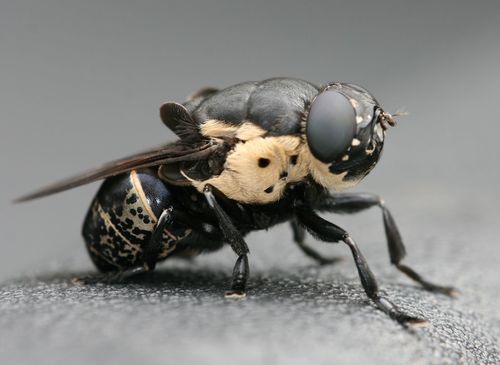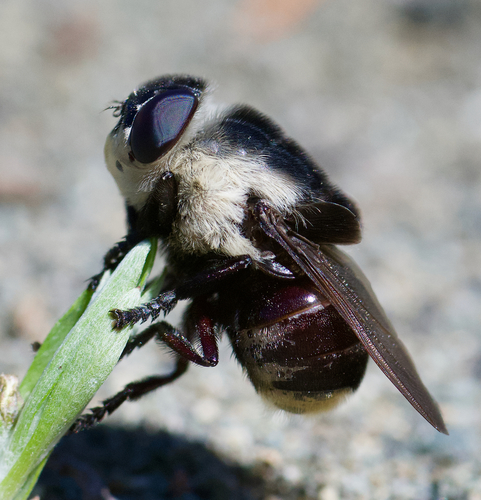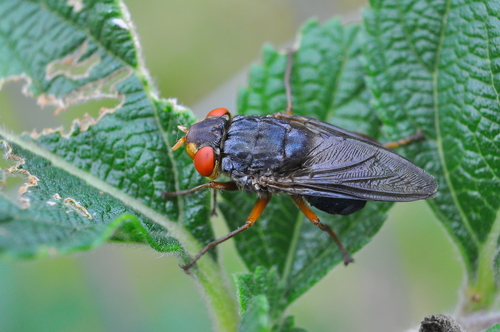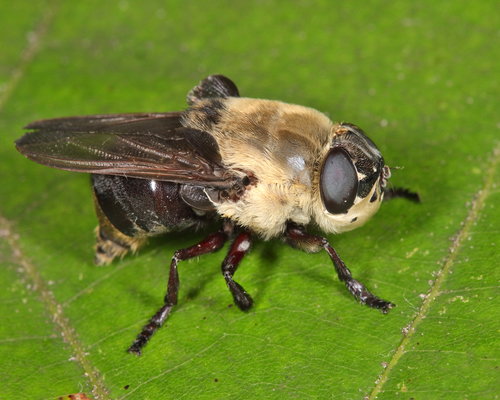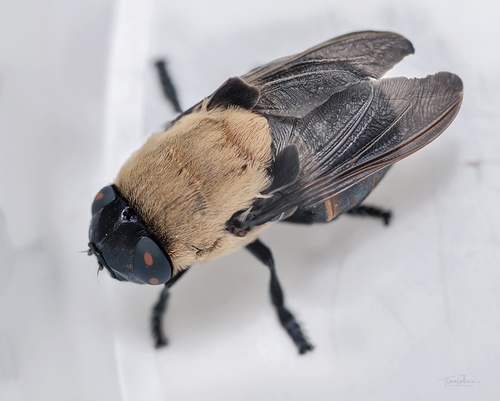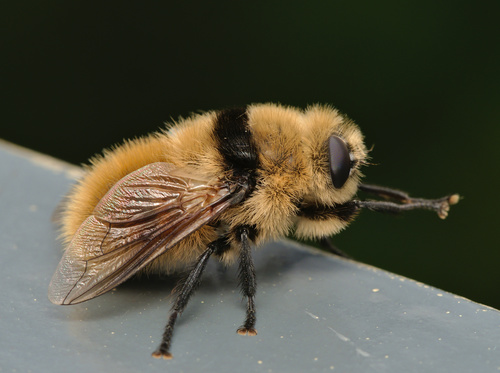
About Cephenemyia stimulator (Clark, 1815)
All larval stages of Cephenemyia are obligate parasites of cervids. For Cephenemyia stimulator, eggs hatch inside the female’s uterus. The female then flies near the head of her host, hovers, and ejects her larvae into the host’s nostrils. The larvae migrate to the base of the host’s tongue, where they mature in clusters, reaching a length between 25 and 36 mm (0.98 to 1.42 inches). After being expelled by the host, the larvae pupate in soil over a period of 2 to 3 weeks. They then emerge as sexually mature, non-feeding adults, which must find a mate quickly due to their short lifespan. Aristotle (384 BC – 322 BC) left a written description of deer botfly larvae: "However, without any exception, stags are found to have maggots living inside the head, and the habitat of these creatures is in the hollow underneath the root of the tongue and in the neighbourhood of the vertebra to which the head is attached. These creatures are as large as the largest grubs; they grow all together in a cluster, and they are usually about twenty in number." Regarding distribution, Cephenemyia species recorded in the United States are C. apicata, C. jellisoni, C. phobifer, C. pratti, and C. trompe. In Scandinavia, the only recorded Cephenemyia species are C. trompe, C. ulrichii, and C. stimulator. Other recorded European Cephenemyia species include C. auribarbis and C. pratti.