About Cephea cephea (Forskål, 1775)
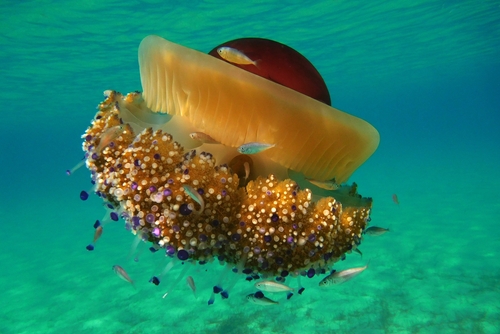
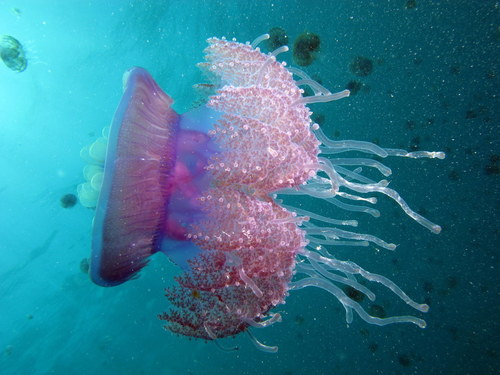
Cephea cephea is purplish-blue, and can grow up to 60 centimeters in bell diameter. It has wart-like projections and a bell-shaped body, which are reflected in its common names. Like other jellyfish, its tentacles hold nematocysts that stun, kill, and catch prey. It has an approximate lifespan of three to six months, and its body is 95% water. This jellyfish species lives in the pelagic zone of the ocean, found in the Indo-West Pacific, Eastern Atlantic, and Red Sea. It thrives in cold water, and can occur at depths of over 3,000 feet below the surface. The species is bioluminescent. It typically stays in deeper water during the day, and migrates to surface waters at night. Its main prey includes algae, shrimp, plankton, and invertebrate eggs and larvae. Sea turtles are the most common known predators of this species. The reproductive cycle of Cephea cephea is similar to that of many other jellyfish. Adult individuals release sperm or eggs into the water, and fertilized eggs develop into planula larvae. The planula attaches to a rock or similar structure, then grows into a polyp. Asexual reproduction occurs, in which the polyp clones itself to develop into the next life stage, called ephyra. The ephyra then grows and develops into a mature adult medusa jellyfish. Water temperature and food availability affect how efficient the asexual reproduction phase is. Cephea cephea is counted among the most venomous jellyfish. While its venom is abundant and deadly to its prey, its stings and venom are not harmful to humans. It is harvested for food by people, mainly in Japan and China, where it is considered a delicacy. This species is also used for human medicinal purposes.