About Cephalotus follicularis Labill.
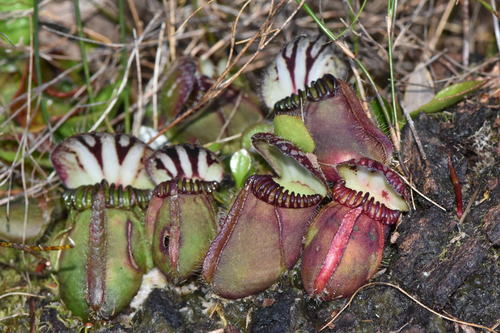
Cephalotus follicularis Labill., commonly known as the Australian pitcher plant, is a small, low-growing herbaceous species. Evergreen non-carnivorous leaves grow from underground rhizomes; these leaves are simple with smooth, unbroken margins and lie close to the ground. Its carnivorous leaves are small, shaped like booties or moccasins, and form the characteristic pitcher that gives the plant its common name. Pitchers develop a dark red color when grown in high light, but remain green in shadier conditions. All foliage grows in a tight basal arrangement, with adapted leaf blades facing outward, bringing the total height of the plant to around 20 cm. The pitcher trap of this species works similarly to traps of other pitcher plants. The peristome, which rims the trap entrance, has a spiked structure that lets prey enter but blocks their escape. The lid covering the entrance, called the operculum, stops rainwater from entering the pitcher and diluting the digestive enzymes inside the trap. Insects trapped in this digestive fluid are digested and used by the plant. The operculum has translucent cells that look like patches of sky to insect prey, confusing them. The plant's inflorescence is made up of clusters of small, hermaphroditic, six-parted, symmetrical flowers that are creamy or whitish in color. During the cooler winter months, when temperatures drop to around 5 degrees Celsius, the plant enters a natural 3–4 month dormancy period triggered by lower temperatures and reduced light levels. This plant is endemic to southwestern Australia, where it grows in a 400-kilometer (250-mile) coastal zone between Augusta and Cape Riche, northeast of Albany. It occurs mainly in sphagnum moss cushions on consistently moist, well-drained, acidic peat soil over granite, found in seeping areas, along riverbanks, or under clumped tussock grasses, such as those in the family Restionaceae. It is also recorded in the Warren, southern Jarrah Forest, and Esperance Plains regions of the Southwest botanical province's southern coastal districts. Its typical habitat includes moist peaty sands in swamps or along creeks and streams, but it can tolerate less damp conditions. The IUCN categorizes the Australian pitcher plant as Vulnerable because of its restricted distribution. However, there is no immediate acute threat to the species; because parts of its distribution range are protected and the plant is common within that protected area, it has been removed from CITES Appendix II. The IUCN classification of Vulnerable (VU A2ac; C2a(i)) does not match national and state Australian threat listings: both Australia's national EPBC Act List of Threatened Species and Western Australia's Wildlife Conservation Act 1950 list the species as Not Threatened. Wild populations have declined due to habitat destruction and overcollection. The larvae of Badisis ambulans, an ant-like, wingless fly in the family Micropezidae, develop only inside the pitchers of this species, and have never been found anywhere else. Cephalotus follicularis can survive occasional undergrowth bush fires by resprouting from its rhizome, though its seeds are not adapted to survive fire. The Australian pitcher plant is popular among carnivorous plant enthusiasts and is cultivated around the world, but it is considered difficult to grow successfully. In cultivation during the growing season, the plant prefers warm daytime temperatures up to 25 degrees Celsius, paired with cool nighttime temperatures. It is commonly grown in a growing medium of sphagnum peat moss, perlite, and sand, and prefers a humidity between 60–80%. It can be successfully propagated from root cuttings and cuttings from non-carnivorous leaves, though pitcher leaves can also be used for propagation. A dormancy period is thought to be critical for the plant's long-term health. Cultivated plants kept in direct sunlight develop rich coloration and grow vigorously, while plants grown in bright shade stay green. Living plants of this species were first brought to Kew Gardens by Phillip Parker King in 1823. A cultivated specimen flowered in 1827, and provided source material for an illustration published in Curtis's Botanical Magazine. This species has received the Royal Horticultural Society's Award of Garden Merit. Several dozen different Cephalotus clones exist in cultivation, and nine have been officially registered as cultivars. One of the best known is 'Eden Black', a cultivar that produces unusually dark-colored pitchers.

