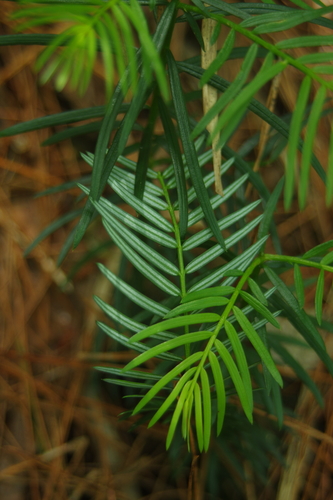
About Cephalotaxus harringtonia (Knight ex J.Forbes) K.Koch
New shoots of Cephalotaxus harringtonia remain green for three years after forming, and have ribs at the leaf bases. The buds are green, globular in shape, and very small, at only 1 mm in length. There is one rank of leaves on either side of the shoot; these leaves rise up above the shoot and curve slightly inwards, forming a narrow V-shape somewhat similar to a dove's wings. The leaf ranks are often vertical, but may be more flattened in shaded areas. The leaves are broadly linear, measuring about 5 cm long by 0.3 cm wide. They are abruptly pointed at the apex, leathery in texture, and bright matte yellowish-green on the upper surface. The abaxial (underside) of the leaf bears two broad, pale to silvery stomatal bands. This species is dioecious. Male plants are typically densely covered with pairs of cones that are pale cream, turning brown with age, and globular in shape. The male cones are borne on 2 to 4 mm stalks beneath each pair of leaves, and pollen is released from March until May. On male and female trees in South Korea, cones emerge from March to May. Female plants produce two pairs of knob-like globose cones on curved stalks at the bases of the shoots. Mature female cones are obovoid, measuring 2.5 cm long by 1.5 cm wide. When immature, they are smooth and pale green with dark green stipes, and turn brown when ripe. This species is native to China, the Korean peninsula, Japan and Taiwan. In South Korea, it occurs in Gyeonggi-do and southern mountainous forests. In Japan, it is found from Kyūshū in the south to Hokkaidō in the north; specifically, it grows on Mount Kiyosumi in Awa District, Awa Province (Hondo, Chiba Prefecture), and also occurs in Nagasaki Prefecture and Hiroshima Prefecture. The variety nana occurs in eastern Honshū and Hokkaidō, most commonly on seaside cliffs and in mountainous areas. Cephalotaxus harringtonia thrives in partial shade on deep, rich soils. It has been cultivated in the United Kingdom since 1829, and is an infrequently encountered garden specimen. It is the most commonly seen species of the genus Cephalotaxus in western gardens. Several cultivars exist: the cultivar 'Fastigiata' was first selected in 1861 in Japan. It grows to 6 metres in height, and is characterized by a broad cluster of erect stems and very dark green leaves that spread all around the stem and are strongly decurved. Shoots are unbranched in the upper portions of the plant, while the lower portions have somewhat chaotic projecting side-shoots that hang down and hold leaves in flat ranks. The flowers of 'Fastigiata' are inconspicuous.

