About Cephaloscyllium ventriosum (Garman, 1880)
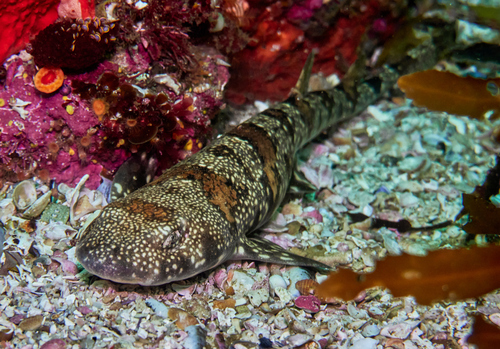
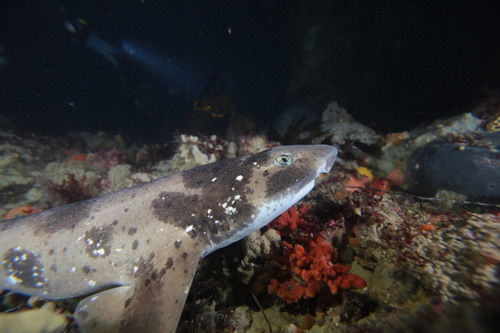
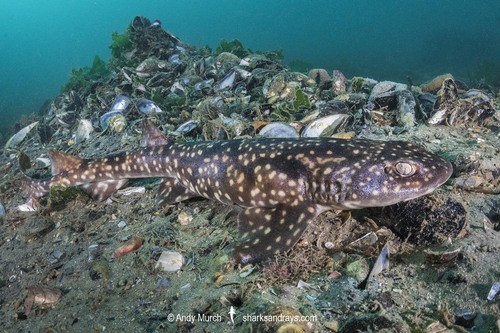
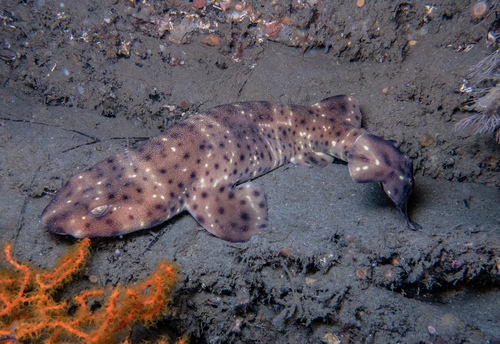
Cephaloscyllium ventriosum, commonly known as the swell shark, is typically around 90 cm (35 in) long, with a maximum recorded length of 110 cm (43 in). This species has flat, broad heads and large gold eyes that are equipped with nictitating eyelids. Their body is yellow-brown, patterned with brown and white spots. These spots cover the underside of the shark, but do not appear on the fins. Young swell sharks are usually lighter in color than adult individuals. Their gills are typically very small and narrow. Each swell shark has between 55 and 60 teeth. Most teeth have three smooth cusps, though some can have up to five cusps, and the middle cusp is always the longest. The swell shark occurs in the eastern Pacific Ocean, ranging from the central California coast to southern Mexico, with an additional separate population off the coast of Chile. It inhabits waters between 5 and 457 m (16 and 1,499 ft) deep, and is most commonly found at depths from 5 to 37 m (16 to 121 ft). This species is often found over algae-covered rocky bottoms, where it hides in crevices during the day. Swell sharks are nocturnal, sleeping in rock crevices during daylight hours; their natural patterning and coloration lets them camouflage effectively in this habitat. They are highly sociable, and are commonly found sleeping next to or on top of other swell sharks. Swell sharks are oviparous, and lay two flattened green or amber eggs at a time. Fertilization takes place internally. Tendrils attach the egg cases to kelp or reef substrate. It has been suggested that the length of these tendrils changes based on the amount of surf action in the local area. No parental care is provided after the egg cases are produced. The egg case holding the embryo measures approximately 2.5 centimeters (0.98 in) to 5.1 centimeters (2.0 in) by 7.6 centimeters (3.0 in) to 13 centimeters (5.1 in). Before hatching, embryos feed exclusively on yolk. Gestation length depends on water temperature, and is usually between 9 and 12 months. New pups have a double row of enlarged dermal denticles that help them exit the egg case. After hatching, pups are approximately 15 cm (5.9 in) long and are fully self-sufficient.