About Cephaloscyllium laticeps (Duméril, 1853)
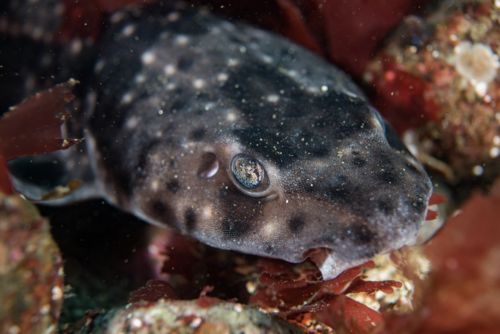
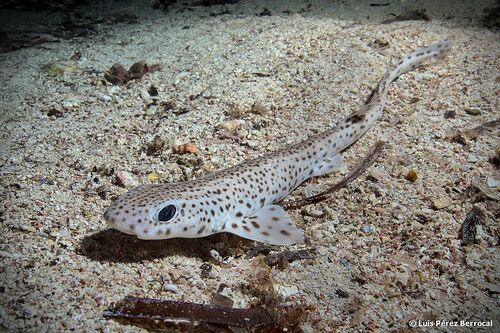
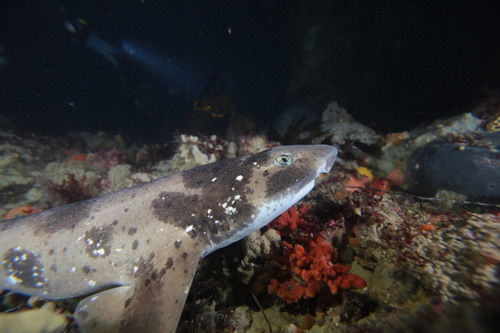
The Australian swellshark, scientifically named Cephaloscyllium laticeps (Duméril, 1853), has a stocky, rounded body that tapers sharply to a short caudal peduncle. Its head makes up no more than one-fifth of its total length; it is broad, moderately flattened, and bears a very short, thick, blunt snout. Short triangular skin flaps divide the nostrils into small incurrent and excurrent openings, and these flaps do not reach the mouth. The mouth is extremely large, with no furrows at its corners. This shark has numerous small teeth with multiple cusps, and its upper teeth stay exposed when the mouth is closed. Its large, oval eyes sit somewhat on the upper surface of the head, and have rudimentary protective third eyelids called nictitating membranes, plus ridges beneath the eyes.
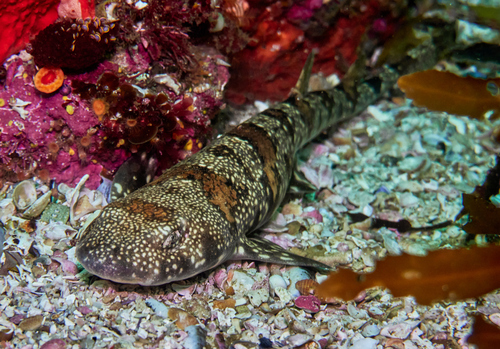
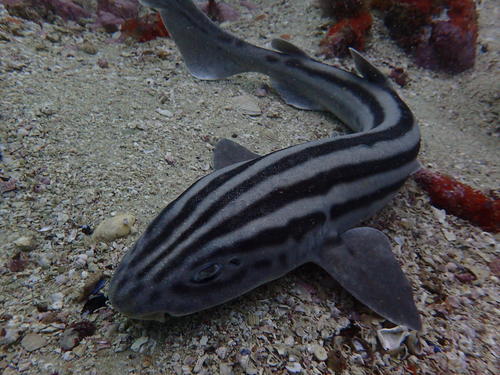
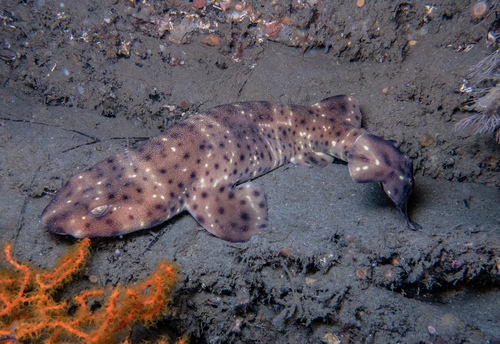
There are two dorsal fins, with the first being much larger than the second. The first dorsal fin originates over the forward half of the pelvic fin bases, while the second dorsal fin sits over the anal fin. The pectoral fins are large and broad, and the anal fin is larger than the second dorsal fin. The short, broad caudal fin has an indistinct lower lobe and a distinct ventral notch near the tip of its upper lobe. The shark's thick skin is covered in well-calcified, arrowhead-shaped dermal denticles, which are sparser in young individuals. The back and sides range from light grey to brown, marked with an irregular pattern of closely spaced darker saddles and blotches, plus many dark (sometimes light) spots, and a dark stripe that runs from under the eye to the origin of the pectoral fins. The fins do not have sharply lighter margins. The underside is cream-coloured, with some mottling on the fins, and adults often have a dark stripe running down the middle of the underside. The maximum recorded total length of this species is 1.5 m (4 ft 11 in), though few individuals grow longer than 1.0 m (3 ft 3 in).
This species inhabits the continental shelf of southern Australia, ranging from the Recherche Archipelago off Western Australia to Jervis Bay in New South Wales, and includes Tasmania in its range. It is commonly found on or near the seabed among rocky reefs or seaweed beds, from areas close to shore down to a depth of 220 m (720 ft).
The Australian swellshark is the most abundant catshark species in the coastal waters of southern Australia. It is generally a sluggish swimmer, and is more active during the night. During the day, it often rests alone or in groups under ledges or inside caves. Tracking studies show that some individuals stay continuously active for months at a time, while others alternate activity with stationary rest periods that can last up to five days. Most individuals in a given region stay in that area year-round, regularly using established feeding areas or preferred habitats. A small minority of individuals have been recorded traveling distances of up to 300 km (190 mi). This is an extremely hardy species that can survive for more than a day out of water.
As a higher-level predator in its ecosystem, the Australian swellshark feeds on crustaceans (especially crabs and rock lobsters), cephalopods (including squid and octopus), and small fish. Even large prey is usually swallowed whole, and the long rest periods seen in some sharks may be linked to digestion. Like other members of its genus, this shark can rapidly inflate its body by taking water or air into its stomach as a defense against predators, which include larger fish such as the broadnose sevengill shark (Notorynchus cepedianus) and marine mammals. Inflating allows the shark to wedge itself into rock crevices, make itself harder for predators to swallow, or intimidate potential attackers. Marine snails are known to prey on this shark's eggs. The Australian swellshark hosts a number of parasite species, but these parasites are not well documented.