About Cephaloscyllium isabellum (Bonnaterre, 1788)
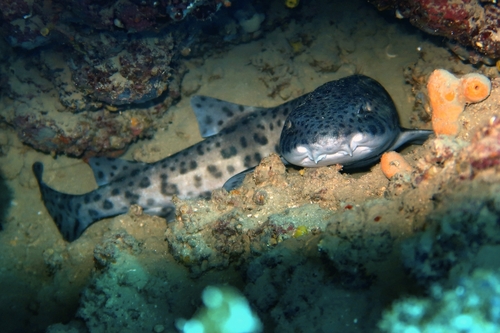
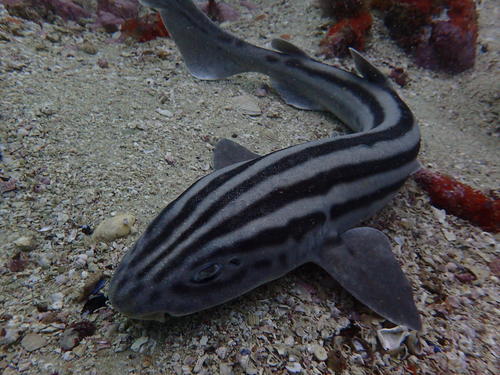
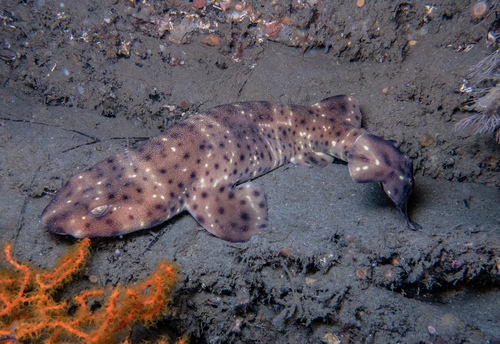
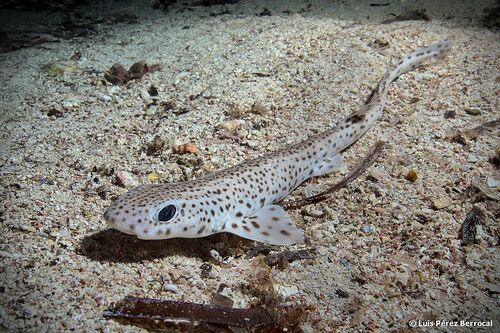
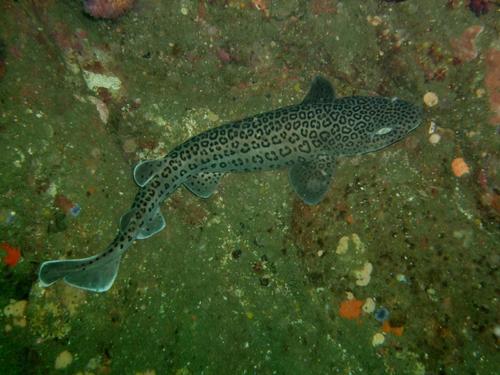
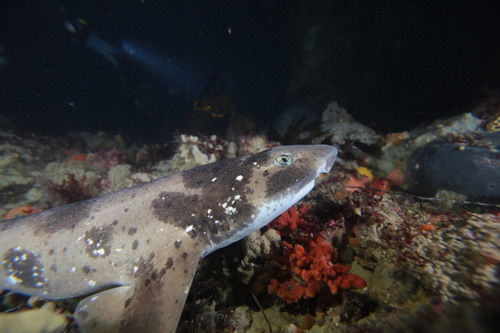
Most draughtsboard sharks (Cephaloscyllium isabellum) grow no longer than 1 m (3.3 ft), though rare individuals can reach 1.5 m (4.9 ft); the reported maximum size of 2.4 m (7.9 ft) most likely refers to the broadnose sevengill shark (Notorynchus cepedianus) or another unrelated species. Females of this species grow larger than males. Draughtsboard sharks have a stocky, spindle-shaped body that tapers to a relatively thin caudal peduncle. Their head is short, broad, and somewhat flattened, ending in a broadly rounded snout. A triangular flap of skin sits in front of each nostril, and this flap does not extend to the mouth. The oval eyes, which sit partway on top of the head, have rudimentary nictitating eyelids, thick ridges above and below them, and are followed by spiracles. The mouth is very large and curved, with no furrows at the corners, and the upper teeth stay exposed even when the mouth is closed. The pectoral fins are fairly large and broad. Both dorsal fins are positioned far back on the body; the first originates roughly over the middle of the pelvic fin bases, and the second originates over the anal fin. The second dorsal fin is much smaller than the first, and also smaller than the anal fin. Males have short, thick claspers. The caudal fin is short and broad, with a barely developed lower lobe and a prominent ventral notch near the tip of the upper lobe. The shark's thick skin is covered in well-calcified dermal denticles. This species gets its common name from its characteristic colouration: it is golden to brown on its upper side and light on its underside, with up to 11 dark brown, irregular dorsal 'saddles' that alternate with blotches on the flanks to create a checkerboard pattern. A second distinctive marking is the saddle between the spiracles, which is stretched and swept back on each side to form a bar across the gill slits. The draughtsboard shark is found in coastal waters around Tasmania and New Zealand, including the Snares, Chatham Islands, and Stewart Island, where it is especially common. It most often lives at depths between 0 and 400 m (0 to 1,312 ft) on continental and insular shelves, though it has been recorded as deep as 673 m (2,208 ft). It is a bottom-dwelling species that prefers rocky reefs and adjacent soft substrate areas. Adult males and females live separately from one another. During the day, draughtsboard sharks are lethargic and usually hide inside reef crevices or caves. At night, they leave their hiding spots to forage for food across nearby sandy flats. They eat a wide range of fishes and invertebrates, including spiny dogfish, cod, sand perch, blennies, octopus, squid, gastropods, innkeeper worms, krill, hermit crabs, crabs, spiny lobsters, and even sea squirts. Individual sharks have been observed sucking innkeeper worms out of their burrows, and swimming for hours with the antennae of large lobsters protruding from their mouths. A known parasite of the draughtsboard shark is the tapeworm Calyptrobothrium chalarosomum. Like other species in the genus Cephaloscyllium, the draughtsboard shark can dramatically inflate its body as a defense against predators; this ability may explain reports of the species barking like a large dog. It usually inflates its body with water, but if captured by humans and brought to the surface, it may inflate with air instead. When the shark deflates, the 'bark' sound is created by pressurized air being released explosively through the cardiac sphincter of the stomach. The draughtsboard shark is oviparous, and females lay two eggs at a time. The smooth, cream-coloured egg cases are 12 cm (4.7 in) long, with long spiral tendrils at the corners that anchor them to underwater objects. Newly hatched sharks measure 16 cm (6.3 in) long; males reach sexual maturity at 60 cm (24 in) long, while females mature at 80 cm (31 in) long.