About Cephalorhynchus heavisidii (Gray, 1828)
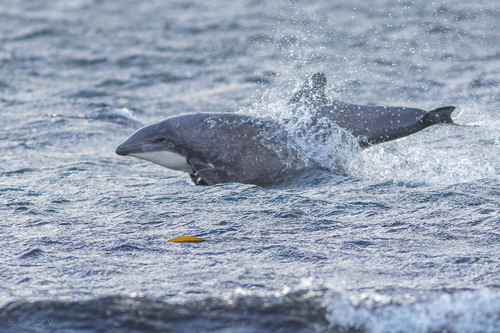
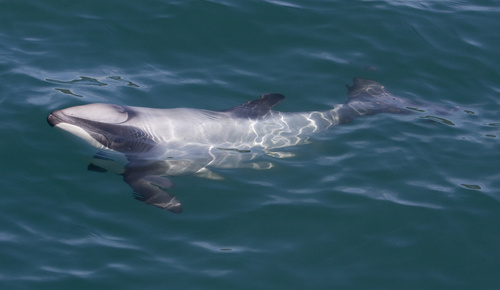
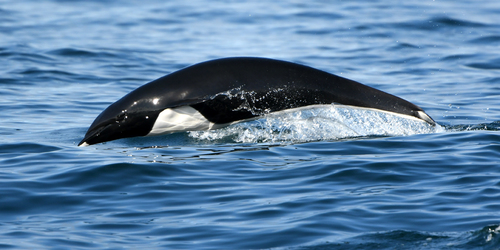
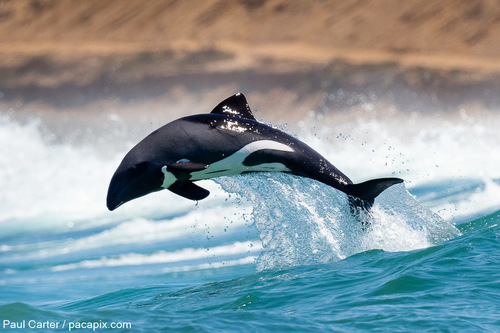
Heaviside's dolphin, with the scientific name Cephalorhynchus heavisidii (Gray, 1828), is a small, stocky dolphin. Adult individuals reach a maximum length of 1.7 m (5.6 ft) and a maximum weight of 75 kg (165 lb). This species has a distinct black, grey, and white body pattern, so it is not easily confused with any other species found in its range. Its head is cone-shaped with a blunt beak, and its triangular dorsal fin sits in the middle of the back. The head and thorax are light grey, with darker patches surrounding each eye. The dorsal fin, fluke, and dorsal cape range from dark grey to nearly black, with a band that extends forward from the dorsal fin to the blowhole. The underbelly is white, with white bands that extend onto the lower rear of the body. Small white patches are located just behind the pectoral fins, and a single white patch stretches between these fins on the chest. Sexual dimorphism in this species is minimal, but the shape of the white patch that covers the genital slit differs clearly between genders: the patch ends in a point in males, while it widens to cover the mammary slits in females. This species is strongly tied to the cool waters of the Benguela Ecosystem. While Cape Point is listed as the southern limit of its range, the actual southern limit, beyond which sightings are extremely rare, is Hout Bay, around 25 mi (40 km) north of Cape Point. This small distance is meaningful for the species, since it shows very high site fidelity to quite small nearshore spatial scales. From this southern point, the species occurs more or less continuously along 1,600 mi (2,500 km) of coastline northward: along the South African coast, through Namibia, and into southern Angola. The northern boundary of the species' range remains poorly defined. A small number of dolphins have been sighted or accidentally caught by fishing vessels north of the Angola-Namibia border, but no sightings were recorded during a series of coastal scientific surveys at Tombua, which lies approximately 170 km inside Angola, well south of the formally defined northern boundary of the Benguela Ecosystem. The northern boundary of the Benguela Current shifts north and south seasonally, and because Heaviside's dolphins are closely linked to its cool waters, their northern range limit may shift along with changing water conditions. Systematic surveys have mapped the species' distribution in southern South Africa, and current research focuses on local populations in Walvis Bay and Lüderitz, Namibia. These two sites, along with Table Bay in Cape Town and Britannia Bay in South Africa, are popular dolphin watching hotspots. Sightings are common from land, and several dolphin watching tour companies offer boat tours to see Heaviside's dolphins. Recent genetic research has found evidence of population structure across the species' range, showing two distinct north and south metapopulations with limited genetic exchange between them. This pattern of population fragmentation is shared by the other three species in the genus Cephalorhynchus, and is most pronounced in Hector's dolphin, which shows genetic isolation over very short distances. Heaviside's dolphins typically stay nearshore in the mornings, where they socialize and rest. When nearshore, their distribution patterns are remarkably predictable both within a single year and across multiple years, as the animals consistently use aggregation sites at the exposed western tips of most bays throughout South Africa and Namibia. They are rarely seen in the protected shallow waters of these bays. Outside of bays, they occur in relatively high densities along exposed sandy beaches, though these areas are likely a secondary choice. Heaviside's dolphins prefer areas adjacent to offshore waters with high abundance of their main prey: juvenile Cape hake (Merluccius capensis). They are most commonly sighted in waters with surface temperatures between 9 to 15 °C (48 to 59 °F), at depths less than 100 metres (330 ft). Data from satellite telemetry over 2–3 months and photographic resightings over up to 3 years shows Heaviside's dolphins have small home ranges of 31–50 mi (50–80 km). Some individuals have been resighted at the same location for up to 10 years.