About Cephalopterus penduliger P.L.Sclater, 1859
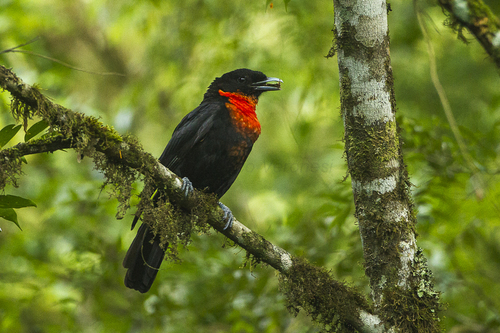
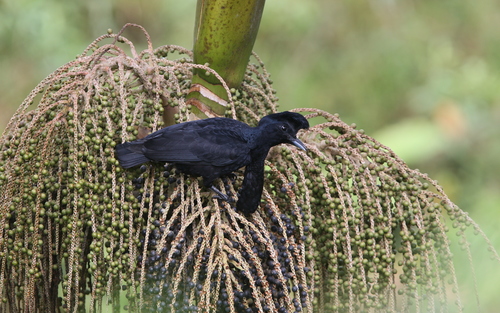
This species, the long-wattled umbrellabird, has the scientific name Cephalopterus penduliger P.L.Sclater, 1859. Males measure 40–42 cm in length, while females are slightly smaller at 35–37 cm. Both sexes have short tails and an erectile head crest; male crests are slightly longer, reaching 20–30 cm. Males can be identified by a large feathered throat wattle, which is absent or much smaller in females and juveniles. The wattle's length can be controlled by the bird, and it can be retracted during flight. Males typically have black-colored shafts in their feathers. The specific epithet penduliger comes from the Latin word pendulus, meaning hanging, and refers to this species' distinctive wattle. This species has a high level of endemism, and occurs from southwestern Colombia to the province of El Oro in Ecuador, within the Tumbes–Chocó–Magdalena bioregion. It lives in humid montane forests at elevations of 1,500 to 1,800 m above sea level, on the ridges and sides of the Andes range. Long-wattled umbrellabirds use a lek mating system: males gather in shared display areas called leks, which are visited by solitary females. Females choose males based on prominent secondary traits such as aggression and territorial behavior. Nests are constructed in trees or tree ferns, and recorded nests have been located 4.5–5.0 m above the ground. Clutch sizes are generally low across the genus Cephalopterus, with only one egg laid per nesting attempt. Incubation takes 27 or 28 days. Only the female incubates the egg and cares for the nestling. She feeds the nestling an average of once per hour, bringing invertebrates, vertebrates, and regurgitated material.