About Cephalopterus ornatus E.Geoffroy Saint-Hilaire, 1809
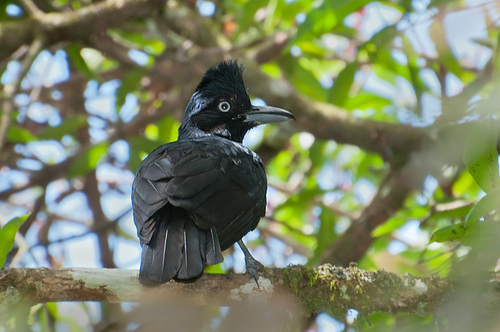
The Amazonian umbrellabird, scientifically named Cephalopterus ornatus E.Geoffroy Saint-Hilaire, 1809, shows strong sexual size dimorphism: males are much larger than females. Males are likely the largest passerine in South America, and the largest suboscine passerine in the world. Males reach a weight of 480–571 grams (1.06–1.26 lb) and a length of 48–55 centimetres (18.9–21.7 in), while females typically measure 41–44 centimetres (16.1–17.3 in) long and weigh up to 380 grams (0.84 lb). Like other umbrellabird species, the Amazonian umbrellabird has almost entirely black plumage, a prominent crest on the top of its head, and an inflatable wattle on its neck that amplifies its loud, booming calls. Unlike other umbrellabirds that have black eyes, this species has pale eyes. Its undulating flight pattern is similar to that of a woodpecker, but it can be distinguished from co-occurring large woodpeckers by the complete lack of white in its plumage. Amazonian umbrellabirds typically only fly across forest openings such as rivers, and when in trees they usually hop boldly from branch to branch.
This species is distributed across almost the entire Amazon basin. Its range extends from the Andean foothills of Colombia, Ecuador, Peru, and Bolivia eastward to southern Venezuela (in the basins of the upper and middle Orinoco River), occurs locally in southwestern Guyana, and reaches Brazil (east to the Negro and Xingú river basins, south to southern Mato Grosso, to the headwaters of the Paraguay River). There are two main populations: one lives in woodland and forest, mainly near rivers, within the Amazon basin, while the other inhabits forested foothills of the eastern Andes. Amazonian umbrellabirds may be found alone, in pairs, or in small groups. They are most often seen in or near the forest canopy, but because they are wary and uncommon in open areas, they are easy to overlook despite their large size. They are more often heard than seen in their natural habitat. They prefer to eat fruit and berries, but will opportunistically consume insects, spiders, and insect larvae.