About Cephalopterus glabricollis Gould, 1851
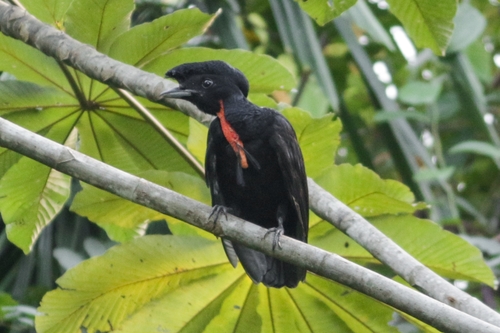
The bare-necked umbrellabird, scientifically named Cephalopterus glabricollis Gould, 1851, is a large, bulky, crow-like bird, and it is the largest passerine within its native range. It ranks among the largest cotingas; only the Amazonian umbrellabird grows larger than this species. Males of this species are larger than females: males measure 41 cm (16 in) in length and weigh 450 g (16 oz), while females measure 36 cm (14 in) in length and weigh 320 g (11 oz).
The bare-necked umbrellabird occurs in Panama, Costa Rica, and southern Nicaragua. Across its distribution, it primarily lives in the subcanopy to upper understory of undisturbed primary forest, though some individuals have been observed foraging in secondary forest. It may also be found in areas with dense understory and close to fruiting trees. This species carries out an annual altitudinal migration tied to the availability of fruit. For most of the year, males reside in lowland areas at elevations between 100–500 m (330–1,640 ft), and females stay at elevations around 200 m (660 ft). During the March to June breeding season, the entire population moves to higher elevations between 1,000–1,500 m (3,300–4,900 ft), a timing that matches the peak fruit availability at these higher elevations.