About Cephalophus dorsalis Gray, 1846
The bay duiker (Cephalophus dorsalis Gray, 1846) is a moderately sized antelope. Typical head-and-body length ranges from 76 to 103 centimeters (30 to 41 inches), and shoulder height for both sexes is 44 to 49 centimeters (17 to 19 inches). Weight does not differ considerably between sexes, with a typical range of 18 to 23 kilograms (40 to 51 pounds). Sexual dimorphism is far less pronounced in this species than in other bovids, though females are often larger than males.
The bay duiker’s tail measures 9 to 11 centimeters (3.5 to 4.3 inches) long, and is black on the outside and white on the inner parts. The tail of the eastern bay duiker ends in a white tuft. Both sexes have a pair of 5 to 8 centimeter (2.0 to 3.1 inch) spiky horns; Rowland Ward recorded a maximum horn length of 12.3 centimeters (4.8 inches) from a specimen collected in Yokadouma, Cameroon. Female horns are generally narrower than those of males.
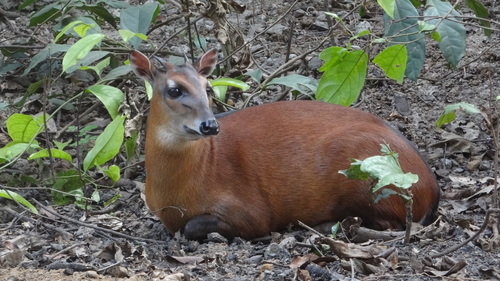
Both sexes have a bright reddish-brown coat; the ventral body and flanks are all reddish-brown, while the legs are dark brown. A prominent, distinct solid black stripe runs from the back of the head to the tail; this stripe is narrower in females. Because the bay duiker is nocturnal, it has large, noticeable eyes. Whiskers grow above the eyes and around the nostrils, and patches of white fur around the whiskers create a sharp contrast with the dark reddish face.
Juveniles have a dark coat, which gradually develops the species’ characteristic stripe and chestnut to reddish-brown color. A juvenile’s face has a dark patch running from the nose to the forehead, separated from the rest of the face by two light brown furrows that extend above or circle the eyes. White spots appear above the eyes, on the lips, and on the chin. The head bears a small dark brown tuft of hair called a crest.
The eastern bay duiker is larger and heavier than the western bay duiker, with larger ears and darker coloration. Its dorsal stripe is wider and lighter in color than that of the western subspecies. The bay duiker is similar to many other duiker species. It cannot be easily distinguished from the red duiker. While Ogilby's duiker resembles the bay duiker in size and coat color, Ogilby's duiker has a paler ventral side, and its dorsal stripe starts at the shoulders rather than the back of the head. There are also large differences in body posture and horn characteristics between the two species. Both the bay duiker and Ogilby's duiker are very similar to the black duiker, differing only in coat color. Peters's duiker also has a dorsal stripe that starts at the shoulders, but this stripe widens to cover the entire rump, just like the fainter stripe on the white-bellied duiker. The bay duiker can be easily distinguished from the black-fronted duiker and Weyns's duiker, which lack dorsal stripes entirely.
The bay duiker prefers old-growth or primary forests. Female home ranges are around 0.2 to 0.4 square kilometers (0.077 to 0.154 square miles), while male home ranges are twice as large as those of females. Historically, this duiker lived in the lowland forested warm, moist rainforests of Guinea. Today, it can be found in moist forested islands and riparian forests in the savannas of Guinea and northeastern Sudan. It is native to multiple countries in western and southern Africa: Angola, Cameroon, Central African Republic, The Democratic Republic of the Congo, Côte d'Ivoire, Equatorial Guinea, Gabon, Ghana, Guinea, Guinea-Bissau, Liberia, Nigeria, Sierra Leone, and Togo. It is thought to be extinct in Uganda.
Because the bay duiker is nocturnal, little is known about its overall behavioral patterns. During the day, it rests against trees or in thickets. It typically stays solitary, though pairs are sometimes observed. The bay duiker is highly alert, and relies heavily on its sense of smell to find food and detect danger. Individuals communicate through preorbital gland secretions and excrement. The leopard is the main predator of the bay duiker; eagles, bonobos, and mandrills may also prey on this species. When alarmed, a bay duiker first stays motionless, and may leap to flee later.
Females may reach sexual maturity and conceive by eighteen months of age. Breeding occurs year-round with no confirmed clear seasonal peaks. A study in Gabon recorded birth peaks before or during periods of maximum fruit abundance. In central Africa, births peak in January and February. Oestrus lasts only eighteen hours. A rutting male will continuously pursue a female in oestrus; he may hum and move his foreleg outward. If the female is receptive, she shifts her tail to the side to allow the male to mount.
Gestation lasts approximately 240 days, and generally results in the birth of a single offspring. Newborn infants weigh around 1,600 to 1,690 grams (56 to 60 oz) and have a dark reddish-brown coat. The brighter adult reddish-brown to chestnut color develops by five to six months of age. For the first few weeks after birth, the infant stays hidden in dense vegetation while its mother is away. Offspring begin eating solid food within a few weeks, and weaning occurs around three and a half months. The average lifespan of a bay duiker is 17 to 18 years.