About Cephalopholis urodeta (Forster, 1801)
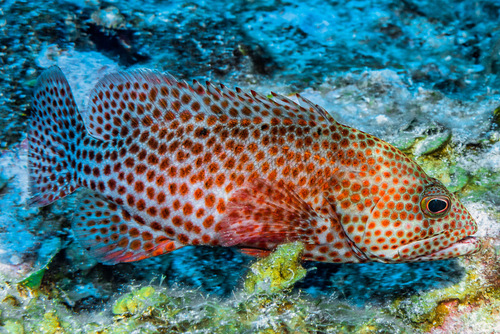
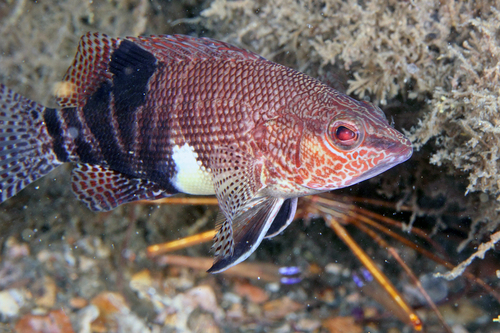
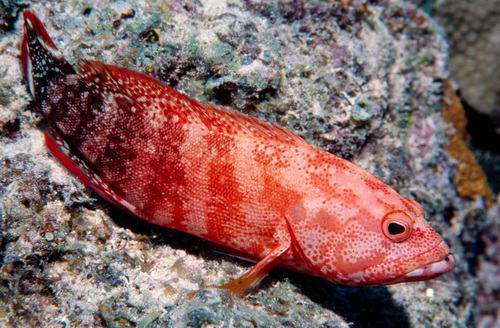
Cephalopholis urodeta (Forster, 1801) has a body that is less deep than the head is long; its body depth is roughly one third of its standard length. The profile between the eyes is convex, the rounded preopercle has a serrated edge and a fleshy lower edge, and the maxilla extends past the eye. The dorsal fin has 9 spines and 14–16 soft rays, while the anal fin has 3 spines and 8–9 soft rays. The caudal fin is rounded, and the pelvic fins do not reach the anus. The overall body color ranges from reddish-brown to pale greyish-brown, and darkens toward the tail, with distinct whitish to pale blue diagonal lines across both lobes of the caudal fin. Six faint dark bars are often present along the flanks, which fork toward the abdomen. Small orange-red spots mark the head and nape, and a pair of dark spots sits near the tip of the lower lip. The pectoral fins are yellowish, and there is typically a large reddish to brownish spot on the edge of the gill cover. This is a small grouper species that reaches a maximum total length of 28 cm (11 in).
Cephalopholis urodeta occurs at Christmas Island in the eastern Indian Ocean, but is primarily a species of the Western Pacific Ocean. Its range extends north to Okinawa and the Ryukyu Islands of southern Japan, and south to the southern Great Barrier Reef in Queensland, Australia. To the east, its range reaches as far as French Polynesia and Pitcairn Island. It has also been recorded from the Phoenix Islands, Jarvis Island, Palmyra Atoll, Kingman Reef, and Brunei. In 1958, over 1,800 C. urodeta specimens collected from the South Pacific were released near Oahu, Hawaii, but the population failed to become established.
This species lives in clear, shallow waters on outer reef areas, in lagoons, behind reefs, and across the top of reefs. It is solitary and prefers healthy coral reefs in shallow regions. Its diet is mostly made up of small fishes, which account for 68% of its food intake, plus crustaceans. It can be found at depths down to 60 metres (200 ft). A single male holds a territory that overlaps the home ranges of up to six females, and the male courts females during the afternoon.