About Cephalopholis spiloparaea (Valenciennes, 1828)
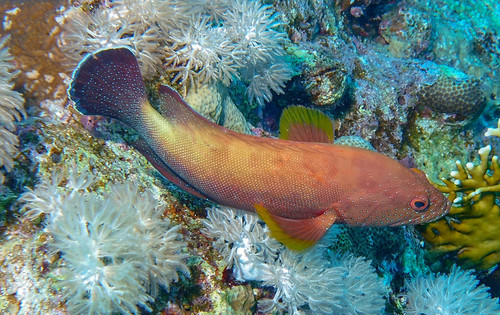
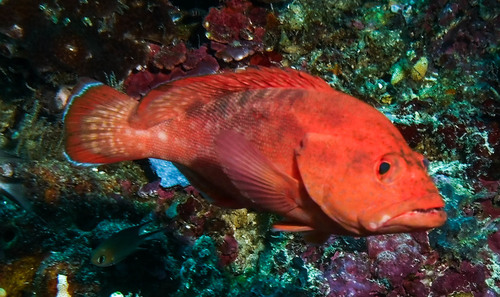
Cephalopholis spiloparaea (Valenciennes, 1828) has a body where standard length is 2.6 to 3 times the body depth. Its dorsal fin has 9 spines and 14-16 soft rays, while the anal fin has 3 spines and 9-10 soft rays. The pectoral fins are noticeably longer than the pelvic fins, and it has a rounded caudal fin. There are 47-53 scales along its lateral line. The base body color is pale reddish orange, marked with dark red or brownish red mottling and blotches. Faint pale spots are normally present on the head, body, and the dorsal, anal, and caudal fins. The caudal fin is typically the same color as the rest of the body, though some specimens collected from the Comoros Islands have distinctly yellowish tails, with a bluish white submarginal band at the tail corners that thins and shifts to the margin at the center of the tail. The margin of the soft-rayed portion of the anal fin, and to a lesser extent the dorsal fin, is bluish. Sometimes, 8 faint dark saddle-shaped blotches run along the base of the dorsal fin, with a ninth blotch on the anterior part of the caudal peduncle. This species reaches a maximum total length of 30 centimetres (12 in).
Cephalopholis spiloparaea has a wide distribution across the Indo-Pacific. Its range extends from the East African coast, from Kenya south to Pinda, Mozambique, east across the Indian Ocean into the Pacific Ocean as far east as French Polynesia and Pitcairn Island. Its distribution reaches as far north as the Ryukyu Islands, and as far south as the Rowley Shoals in Western Australia and Heron Island in the southern Great Barrier Reef, Queensland.
With the exception of the population at Pinda, Mozambique, Cephalopholis spiloparaea is mostly found around islands. It lives on coral reefs at depths greater than 40 metres (130 ft), and is the most common grouper species on this type of reef in the Indo-Pacific. This species lives in harems dominated by a single male. It feeds on crabs and other crustaceans, and typically forages at night or in the very early morning, just before or just after dawn.