About Cephalopholis sonnerati (Valenciennes, 1828)
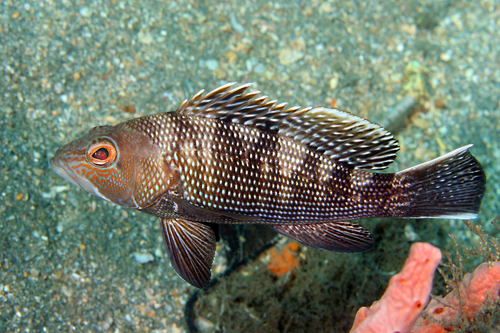
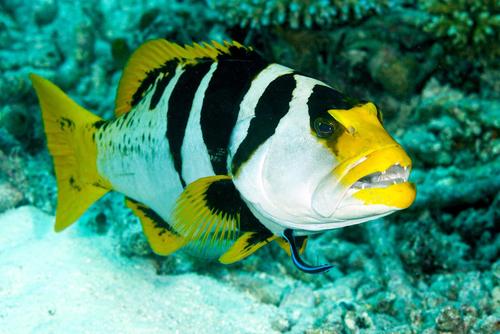
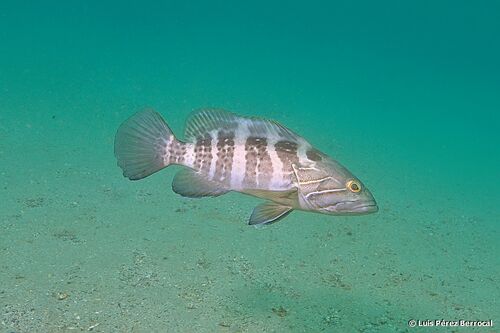
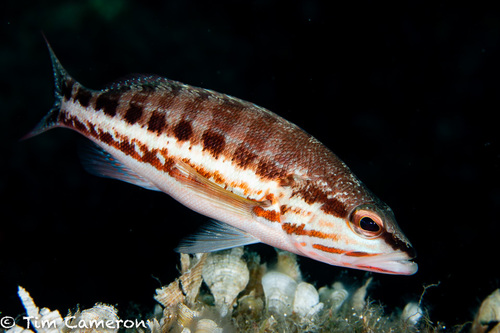
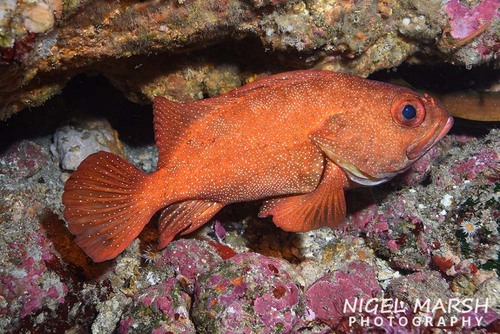
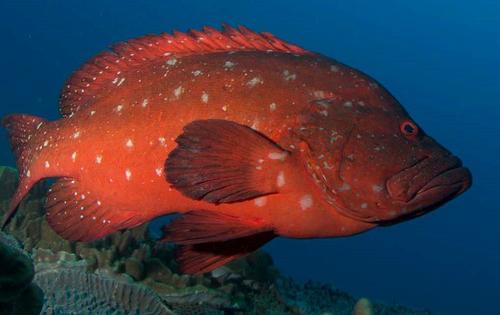
When measured by standard length, the body of Cephalopholis sonnerati is 2.3 to 2.8 times as long as it is deep. In adults, the dorsal profile of the head ranges from straight to concave, while the nape is noticeably convex. Its preopercle is rounded, with fine serrations along its margins, and a shallow cut just above the preopercle angle. The lower edge of the preopercle has irregular serrations, and some of these serrations are enlarged into small, exposed spines. The dorsal fin has 9 spines and 14 to 16 soft rays, while the anal fin has 3 spines and 9 soft rays. The caudal fin is rounded. This is a light reddish-brown grouper, with its body densely covered in rusty spots, and a rounded tail with a white margin. It has a deep, stout body profile, with a dark blotch on the upper section of the gill cover. This species can reach a maximum total length of 57 centimetres, or 22 inches. Specimens collected from the Pacific Ocean typically have a body color ranging from pale reddish brown to yellowish brown, with numerous small, dense brownish spots covering the head, body, and fins. Cephalopholis sonnerati has an Indo-Pacific distribution. Its range extends along the East African coast from the Gulf of Aden south to Durban, South Africa; it reaches east into the Pacific Ocean as far as the Line Islands, north as far as southern Japan, and south as far as Australia. In Australia, it can be found from the Houtman Abrolhos in Western Australia to the area around Darwin, Northern Territory, and from the Cape York Peninsula, Queensland to South West Rocks, New South Wales, as well as at Lord Howe Island in the Tasman Sea. It does not occur in the Chagos Islands, the Red Sea, or the Persian Gulf. Cephalopholis sonnerati lives on deep lagoon reefs, outer reef slopes, and coastal areas with rocky substrate. Juveniles are most often found near sponges or coral heads. This is a solitary species, and adult individuals are usually accompanied by cleaner shrimps. They inhabit moderate depths from 30 to 100 m, which is 98 to 332 ft. It feeds on small fish and crustaceans. Males reach sexual maturity at a length of 34 cm (13 inches), and females reach sexual maturity at 28 cm (11 inches).