About Cephalopholis panamensis (Steindachner, 1876)
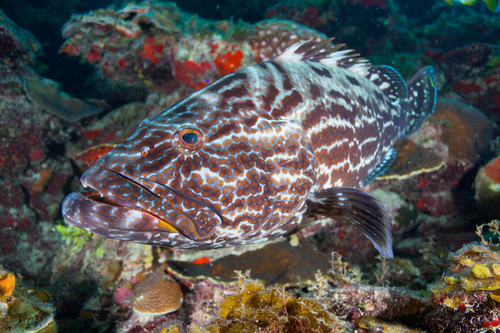
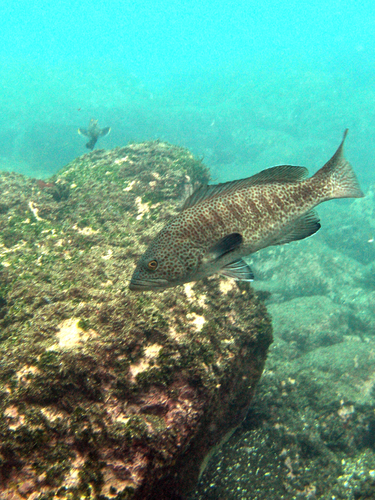
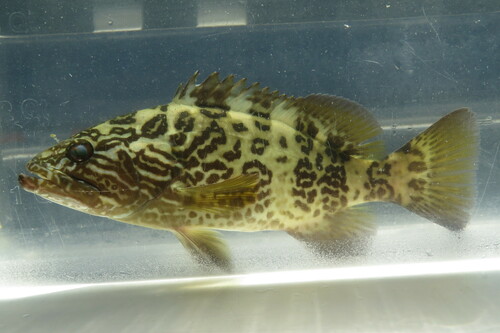
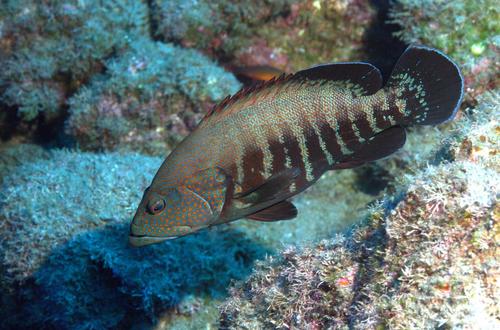
Cephalopholis panamensis (Steindachner, 1876) has a robust, oblong body, a long snout, and a convex profile in the intraorbital region. Most of its teeth are movable. It has a rounded, finely serrated preopercle, and 48 to 49 scales along its lateral line. The dorsal fin has 9 spines, 14 to 15 soft rays, and the third spine is the longest; the dorsal fin membrane is notched between the front spines. The anal fin has 3 spines and 8 soft rays. Adult individuals have a pale grey-brown body with around 9 dark vertical bars along their flanks. Their head is dark, marked with diagonal pale bands, blue and orange spot patterning, and a large dark blotch just behind the eye. The spines of the dorsal fin are dark while the fin membrane is pale; the soft-rayed portion of the dorsal fin is dark, with a pale line along its base. The caudal and anal fins are dark. Juveniles have a medium blue-grey body, and a pale blue-grey lower head marked with orange spots and lines. The upper part of the head and the spiny portion of the dorsal fin are green. The soft-rayed portion of the dorsal fin and the caudal fin are blue-grey, with the caudal fin having a black margin. This species reaches a maximum total length of 39 centimetres (15 in), and most commonly grows to around 20 centimetres (7.9 in).
Cephalopholis panamensis occurs in the eastern Pacific Ocean, with a distribution ranging from the Gulf of California, Mexico to northern Peru. Its range includes Mexico’s Islas Marías and Revillagigedos Islands, the Galápagos in Ecuador, Malpelo Island in Colombia, and Cocos Island in Costa Rica.
Cephalopholis panamensis inhabits rocky shore habitats, and prefers shallower, warmer water than many other species in the genus Cephalopholis. It can also be found on coral reefs. It feeds on fish and crustaceans. This species is a protogynous hermaphrodite; males are larger and older than females, and the overall sex ratio is biased toward more females. It forms harems consisting of one single male and multiple females. Pairs form to court in the evening. Spawning occurs around the full moon, between May and September; in the central Gulf of California, spawning peaks from July to August. Females reach sexual maturity at around 17 centimetres (6.7 in) when they are one and a half years old. Sex change from female to male occurs when individuals reach 20 centimetres (7.9 in) and are at least three years old. This species can live up to 16 years, and it is the most common grouper species across its native range.