About Cephalopholis miniata (Forsskål, 1775)
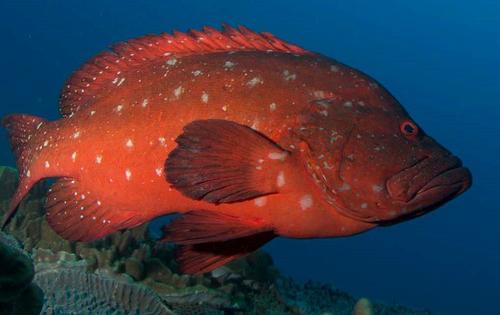
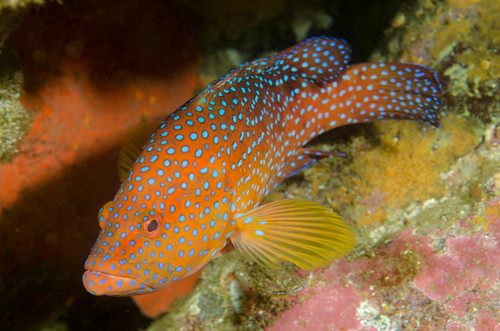
Cephalopholis miniata has a body that is 2.6 to 3.0 times longer in standard length than it is deep. The dorsal profile of the head is flat to slightly convex between the eyes. It has a rounded, finely serrated preopercle with a fleshy lower edge. The maxilla extends past the rear of the eye. The membranes of the dorsal fin have distinct indentations between the spines. There are 47 to 56 scales along the lateral line. The dorsal fin has 9 spines and 14 to 15 soft rays, while the anal fin has 3 spines and 8 to 9 soft rays. The body is colored orange-red to reddish brown, covered in many small bright blue spots that also extend across the head, body, and the dorsal, anal, and caudal fins. Individuals sometimes have diagonal paler bars on the flanks. Juveniles are orange to yellow, with fewer, widely spaced faint blue spots. This species reaches a maximum total length of 50 centimetres (20 in). Cephalopholis miniata has a wide distribution across the Indo-Pacific. It occurs along the eastern coast of Africa from the Red Sea to Durban, South Africa, and extends east through the Indian Ocean into the Pacific Ocean as far as the Line Islands. Its range reaches north to southern Japan and south to northern Australia. It is present at most islands of the Indian Ocean and west-central Pacific, but has not been recorded from the Persian Gulf or the Gulf of Oman. There are also confirmed records from southwestern India and the Andaman Sea coasts of Thailand. In Australia, it is found from the Houtman Abrolhos in Western Australia to Wigram Island in the Northern Territory, and from the northern Great Barrier Reef to Moreton Bay in Queensland; it also occurs at Middleton Reef and Elizabeth Reef in the Coral Sea, and at Lord Howe Island in the Tasman Sea. Cephalopholis miniata lives in clear water on coastal and offshore coral reefs, and prefers exposed areas rather than protected ones. It is often found in caves and below ledges, and occurs at depths from 2 to 150 metres (6.6 to 492.1 ft). Like other groupers, this is a predatory species. More than 80% of its diet is made up of small fish, predominantly the sea goldie (Pseudanthias squamipinnis), which the coral hind ambushes in a sudden rush upward from the substrate. The remaining portion of its diet consists of crustaceans. This species forms harems made up of a single male and up to 12 females. The male defends the harem's territory, which is around 475 square metres (5,110 sq ft) in area. Each female holds a smaller territory that she defends against other females. Coral hinds are protogynous hermaphrodites, changing sex from female to male as they develop. The male patrols the shared territory and visits each female, and the two fish swim parallel to one another when they meet.