About Cephalopholis leopardus (Lacepède, 1801)
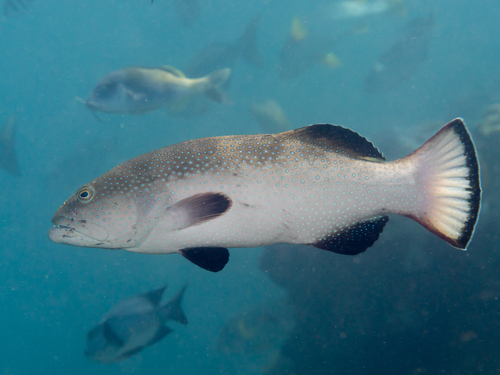
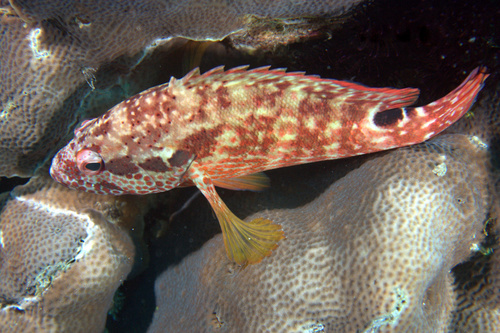
The Leopard grouper, scientifically named *Cephalopholis leopardus* (Lacepède, 1801), is a small to medium-sized fish that reaches a maximum length of 24 cm. Its body is fusiform (spindle-shaped) and laterally compressed, with a rounded caudal fin. It has a large, superiorly positioned mouth. The base body coloration can be light brown, reddish, or light green-gray. The upper portion of the body has blotches that form a marbled pattern, while the lower portion is covered in spots. The front of the snout is covered in small red or dark dots.
This species can easily be confused with *Cephalopholis urodeta*, but differs primarily by having two dark blotches on the upper part of its caudal peduncle. Its caudal fin is marked by two red to dark lines that form a "V" shape, with an additional black line running parallel to the upper line of the V.
*Cephalopholis leopardus* is widely distributed across tropical waters ranging from the Indian Ocean (excluding the Red Sea, Persian Gulf, and South Africa) to the central Pacific islands. Like many groupers, it lives in clear, nutrient-rich waters near coral or rocky reefs. It occurs from the surface down to 40 metres (130 feet) depth, with an average depth range of 3 to 20 metres (6 to 66 feet).