About Cephalopholis fulva (Linnaeus, 1758)
Cephalopholis fulva (Linnaeus, 1758) has an oblong, robust body, with a snout that is longer than the eye diameter. Its eyes are large and round, positioned above a pointed snout. The dorsal profile between the eyes ranges from flat to convex. When the mouth is closed, the posterior end of the upper mandible is exposed, forming a bony knob, and the closed mouth extends past the rear margin of the eye. Most of the species' teeth are movable. The preopercle is rounded, finely serrated, and lacks spines or notches. There are 46 to 54 scales along the lateral line. The dorsal fin has 9 spines and 14 to 16 soft rays, with deep notches between the dorsal spines. The anal fin has 3 spines and 9 soft rays. The caudal fin is convex with angled corners. The maximum recorded total length for this species is 44 centimetres (17 in).
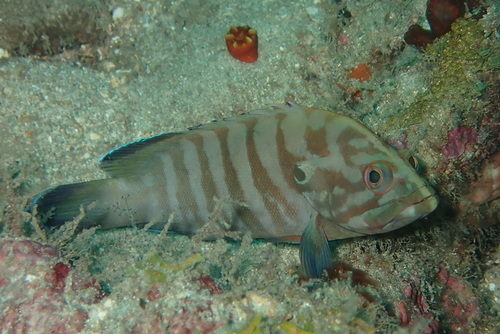
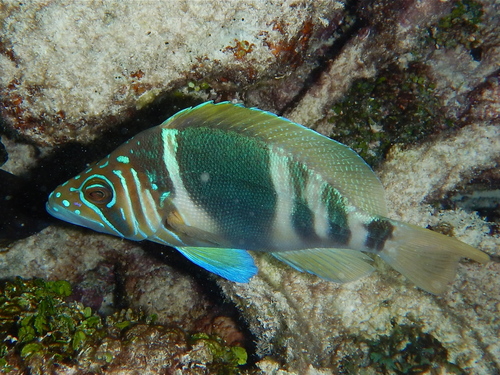
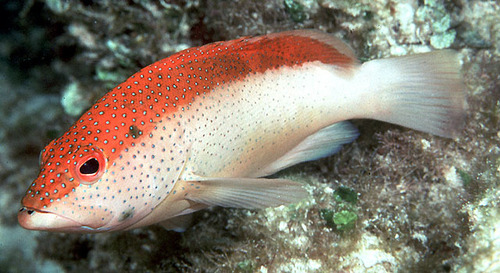
This species displays three distinct colour phases: a deep-water red phase, a shallow-water bicoloured (or orange-brown) phase, and a xanthic (yellow) phase that occurs in both shallow and deep water. The bicoloured phase is normally red or brownish orange above a line running from the tip of the snout to the rearmost dorsal fin rays, and pale below this line. In both the red and bicoloured morphs, the head and body are covered in small blue spots with dark margins. In the yellow morph, these spots are fewer in number and restricted to the head and anterior part of the body. All three colour morphs have two small black spots on top of the caudal peduncle, and an additional two black spots at the tip of the lower jaw. The bicoloured pattern seen in shallow-water morphs appears to be an excitement pattern, and the fish can switch this pattern on and off within a few seconds. At night, the species typically takes on a pale colouration with irregular vertical bars, and a dark forked line between the eyes. When breeding, males develop a horizontal dark brown band running from the lower end of the pectoral fin base to the tip of the caudal fin, a black margin on the soft-rayed portion of the dorsal fin, a dark stripe through the eye, and a white spot on the body near the centre of the dorsal fin base. Juveniles are either bicoloured or uniformly gold, with a white spot on the middle of the back, four black spots on the lower lip, and two white spots on the upper base of the caudal fin.
Cephalopholis fulva is distributed in the western Atlantic Ocean, ranging from South Carolina and Bermuda south to the Bahamas and the Gulf of Mexico. In the Gulf of Mexico, it occurs off Florida from the Florida Keys north to Cedar Key and the Flower Garden Banks; in the western Gulf, it is found from Tuxpan, Mexico south along the coast of the northern Yucatan Peninsula and off northwestern Cuba. It also occurs throughout the Caribbean Sea, and along the northern coast of South America (with a gap around the Amazon Delta) continuing south to southern Brazil. It can also be found around the Fernando de Noronha Archipelago, St. Paul's Rocks, and Trindade Island.
This species inhabits coral reefs and clear water, at depths between 1 and 70 metres (3.3 to 229.7 ft). It may also occur over rocks and coral heads, but only infrequently enters the water column. During the day, it normally shelters in caves or under ledges, and emerges at night to feed on small fish and crustaceans. It has been recorded following moray eels and snake eels to feed on prey flushed out by these predators. Juveniles act as mimics of damselfish.
Cephalopholis fulva is a protogynous hermaphrodite: females reach sexual maturity at a total length of 16 centimetres (6.3 in), and begin sex change to become male when they reach a total length of 20 centimetres (7.9 in). In Bermuda, females are reported to reach maturity at 4 years old. Mature males are territorial and guard harems of females. Spawning occurs at dusk over the course of a few days, with small groups consisting of one male and multiple females taking part. The breeding season can last up to ten months off central Brazil, while shorter breeding seasons are recorded in other areas. On Brazil's Abrolhos Bank, breeding occurs from July to August; in Pernambuco it runs from August to October; at Fernando de Noronha spawning occurs in July and August, and may extend into September. In Bermuda, spawning has been recorded from May to July. The species has a long larval period that allows effective long-range dispersal of young. It is thought to grow most rapidly during early life, attaining around 60% of its maximum possible size in the first year, after which growth rate slows markedly for the rest of its lifespan. Off Brazil, individuals have been reported to reach 25 years of age; fish in tropical areas grow more quickly and have shorter lifespans. The oldest recorded individual was from Bermuda, at 28 years old, and Bermudan individuals are also the slowest growing.