About Cephalopholis cruentata (Lacepède, 1802)
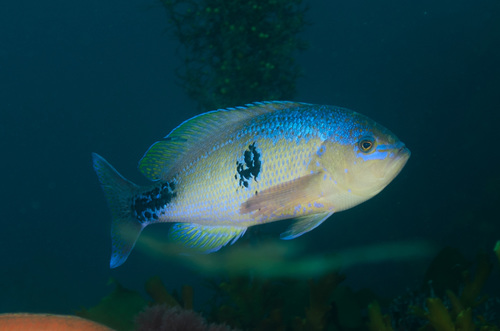
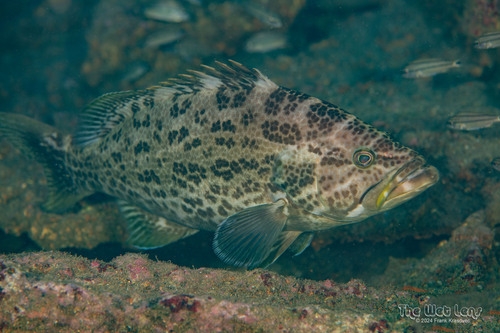
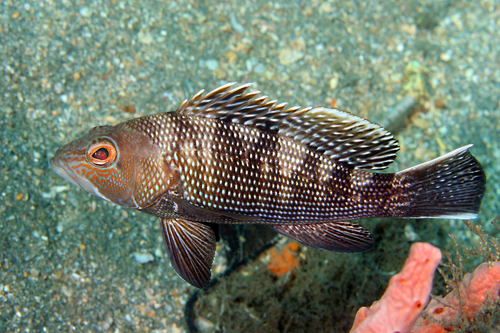
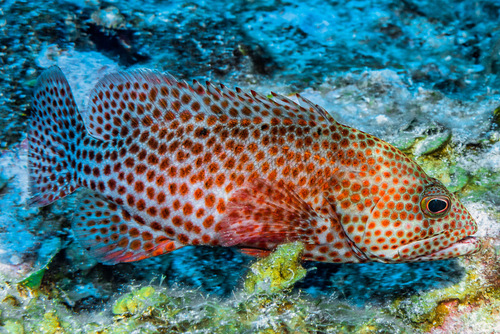
The graysby, Cephalopholis cruentata, has an oblong, robust body and a long snout. When its mouth is closed, the upper jaw protrudes slightly, and there is a bony bump at the maxilla. The dorsal profile of the head between the eyes is flat or slightly convex. Most of its teeth are movable. Its dorsal fin has 9 spines and 13 to 15 soft rays, while the anal fin has 3 spines and 8 soft rays. The rounded preopercle has fine serrations along its margin, with no spines or notches. The operculum, or gill cover, has 3 flat spines: the central spine is the largest, and the upper spine is longer than the lowest one. The caudal fin is rounded, and the pelvic fins are shorter than the pectoral fins. The body is covered in rough scales, and there are 69 to 81 scales along the lateral line. The head, body, and fins are coloured grey, brown, or olive, and are covered in orange-brown spots. There are typically four spots along the upper back, under the dorsal fin, that can change colour between black and white. A white stripe runs from the tip of the lower jaw, between the eyes, and on to the nape. The maximum recorded total length for this species is 42.6 centimetres (16.8 in), though most individuals are around 20 centimetres (7.9 in) long. The heaviest recorded specimen weighed 1.1 kilograms (2.4 lb).
This species is found in the western Atlantic Ocean, the Caribbean Sea, and the Gulf of Mexico, ranging from Cape Fear, North Carolina and Bermuda south to the Caribbean coast of South America. Reports of its occurrence in Brazil require confirmation.
Graysby inhabit Thalassia seagrass beds and coral reefs. In the Gulf of Mexico, they occur on rocky reef ledges at depths greater than 27 metres (89 ft). They are a solitary, secretive species that stays near hiding spots during the day, and prefer to remain within a small home range of approximately 2,120 square metres (0.52 acres), particularly during daylight hours. Graysby are nocturnal predators: adult fish feed mainly on other fishes, with a preference for Chromis multilineata, while juveniles feed on shrimps.
This species is a protogynous hermaphrodite; all individuals start life as female, and become male when they reach middle age. This sex change occurs at 4 to 5 years old, when the fish are between 20 and 23 centimetres (7.9 to 9.1 in) in length, and happens immediately after the spawning period in August and September. Males actively guard a harem, with an average ratio of one male to six females. During spawning, a female releases between 260 and 600 eggs, and the male then releases milt to fertilize the eggs. Graysby can live up to 13 years, and are parasitized by the helminth Pseudorhabdosynochus meganmarieae.