About Cephalopholis boenak (Bloch, 1790)
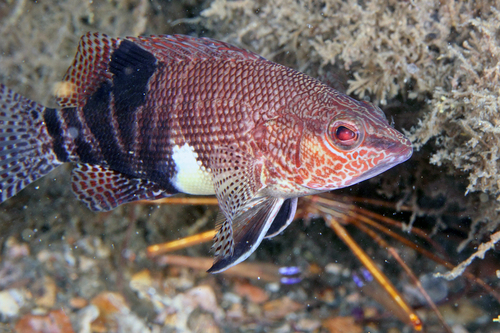
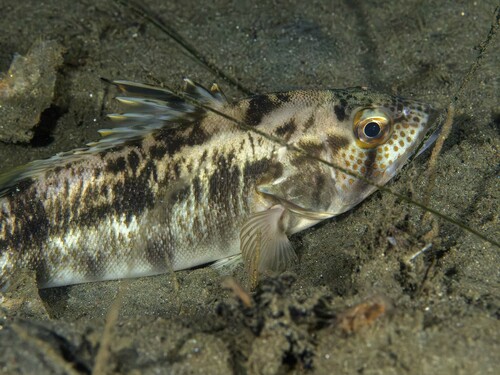
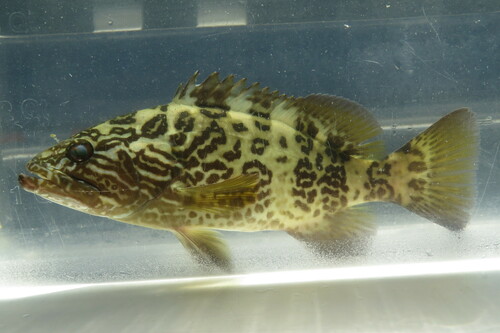
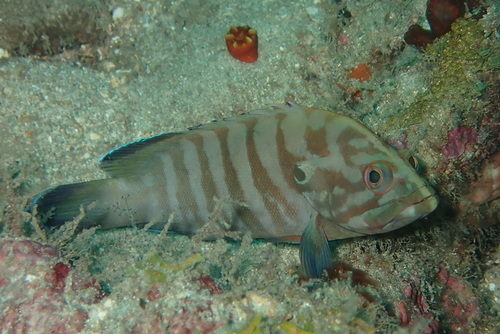
Cephalopholis boenak (Bloch, 1790) has a standard body length 2.6 to 3.1 times its body depth, and a head that makes up roughly one fifth of its standard length. Its dorsal fin has 9 spines and 15 to 17 soft rays, while the anal fin has 3 spines and 8 soft rays. The preopercle is rounded, with fine serrations but no enlarged spines at its angle, and has a fleshy lower margin. A defining characteristic of this species is that ctenoid scales cover the entire body, including the abdomen. The overall body colour ranges from brownish to greenish-grey, and most individuals have 7 to 8 dark vertical bars on their flanks. The dorsal fin has a wide dark submarginal band and a thin white margin; this marking pattern is also found on the anal fins, and on the upper and lower lobes of the caudal fin. There is a blackish spot on the upper margin of the gill cover. Juveniles have yellowish colouration on the rear portion of their body, and a white stripe that runs from the snout to the start of the dorsal fin. This species reaches a maximum total length of 30 centimetres (12 in).
Cephalopholis boenak has a broad distribution across the Indian Ocean and Western Pacific Ocean. Its range extends along the eastern African coast from Kenya south to southern Mozambique, along the southern Asian coast, and into the Pacific Ocean as far north as the Ryukyu Islands and east to New Caledonia. In Australia, it has been recorded along the northern coast from Coral Bay, Western Australia to Moreton Bay, Queensland.
Cephalopholis boenak is primarily a coastal species that inhabits silty, dead, and living coral reefs to depths of up to 30 metres (98 ft). It is a carnivore that feeds mainly on other fishes and crustaceans. Also known as the chocolate hind, this species is a protogynous hermaphrodite, meaning most individuals change sex from female to male, although some individuals are born male. It lives in relatively small social groups made up of one single male, one or two smaller females, and a variable number of sexually inactive individuals, which are either inactive adults or juveniles. Males defend their territories against other males, and a male’s territory is much larger than the home ranges of the females in the group. Males visit females and other fish within their territory at specific locations, almost always following the same route. Courtship takes place in the late afternoon, but breeding behaviour is not tied to any particular moon phase, and can occur multiple times over a single breeding season.