About Cephalocereus macrocephalus F.A.C.Weber ex K.Schum.
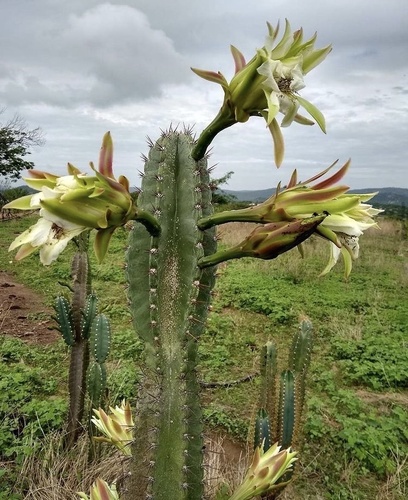
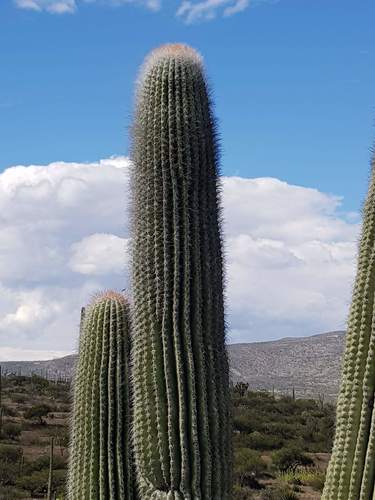
Cephalocereus macrocephalus F.A.C.Weber ex K.Schum. typically grows in branched clusters, though it may occasionally grow as a single stem. Mature plants reach heights of 7 to 15 meters, with trunks measuring 30 to 60 centimeters in diameter. Its columnar shoots are cloudy green, growing up to 12 meters long with a diameter of 30 to 40 centimeters. The species has 17 to 26 low, blunt ribs. It produces 1 to 3 central spines that are 4 to 5 centimeters long, one of which is flattened. There are 8 to 12 spreading, grayish marginal spines, each up to 1 centimeter long. A terminal pseudocephalium is made up of large areoles that carry abundant yellow wool and numerous bristles. Cylindrical to tubular flowers grow in a circle from the pseudocephalium near the tips of shoots. The flowers are white, 1.2 to 1.6 centimeters long, and have a diameter of 2.1 to 2.8 centimeters. The pericarpel and flower tube are covered in small tubercles and broad scales. Fruits are purple-red and spherical, growing up to 2 centimeters long and covered in scales. This cactus is widespread in the Tehuacán Valley, located in the Mexican state of Puebla. The flowers of Cephalocereus macrocephalus are primarily nocturnal: they open at sunset around 19:00 and close by 10:00 in the morning. The bats Choeronycteris mexicana, Leptonycteris curasoae, and Leptonycteris nivalis are the main pollinators that enable seed production for this species. Fruits ripen between June and August, and are eaten by bats and bird species that likely act as seed dispersers. Methylotrophic bacteria are part of the microbiota associated with this species, found both on the surface of its stem and inside the plant. It has been suggested that these bacteria may be linked to growth promotion for Cephalocereus macrocephalus, but this function has not yet been demonstrated.