About Cepaea nemoralis (Linnaeus, 1758)
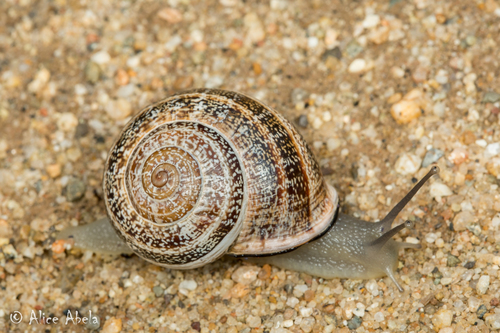
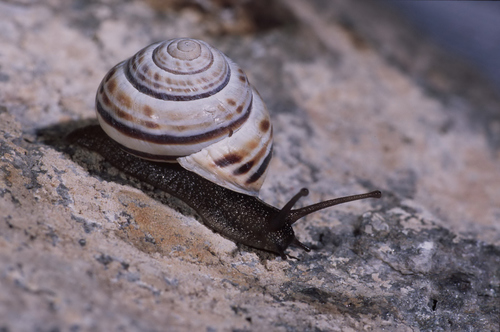
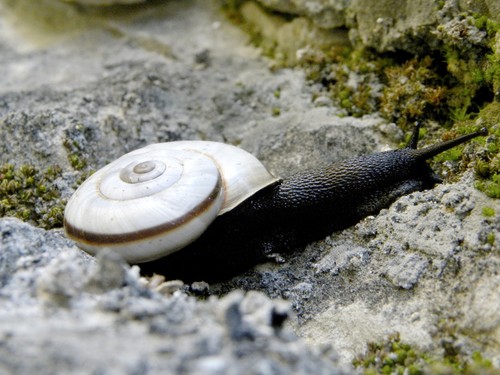
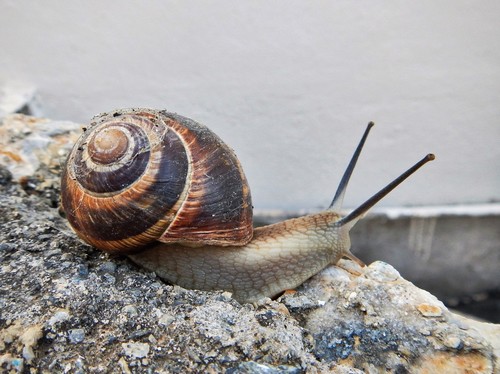
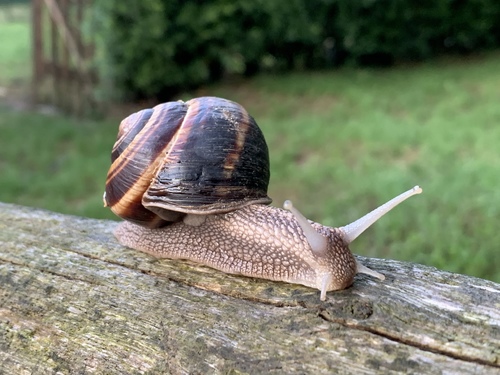
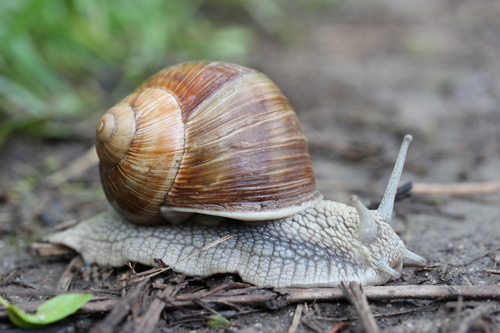
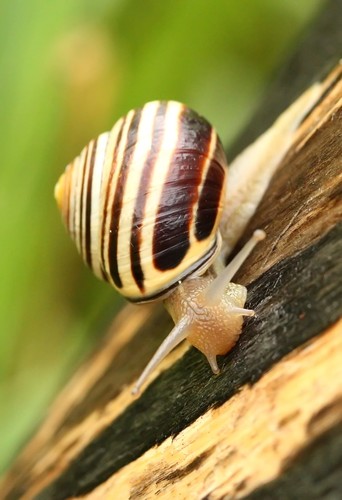
Cepaea nemoralis (Linnaeus, 1758) is among the largest and most well-known snails in Western Europe, in part because of its bright shell colouration. Its shell colour is highly variable, ranging from brown, through pink, to yellow or even whitish, and may or may not have between one and five dark-brown bands. In the nineteenth century, many separate names were created for these colour variants, but this naming system has been replaced by independent scoring of shell colour, plus the presence, absence and fusion of individual bands that are numbered 1 to 5. The thickened, slightly out-turned apertural lip of adult snails is usually dark brown, but can be white in some regions. The umbilicus is closed in adult individuals, but remains narrowly open in juveniles. The shell surface is semi-glossy. A full-grown adult shell has 4½–5½ whorls, with a width of 18–25 millimetres (3⁄4–1 in) and a height of 12–22 mm (1⁄2–7⁄8 in).
Cepaea nemoralis is native to Western, Northern and Central Europe, but has been spreading eastwards especially over the last several decades. It is found across most of the Iberian Peninsula, France, Great Britain, Ireland, Belgium, the Netherlands, Germany, Denmark, southern Sweden and Norway, Switzerland, Austria, the Czech Republic, Hungary, Bosnia, Croatia, and the northern half of Italy. In Central and Eastern Europe, it has spread particularly along the Baltic coast, including in Poland, Latvia, Estonia, southern Finland, and the east coast of Sweden, but it now also occurs elsewhere in Poland, as well as in Ukraine, Belarus and Russia. As of 2020, it was only known from a single garden centre in Slovakia. The first confirmed reports from Romania and Bulgaria each record only one very small local occurrence within a city. At the northern edge of its range, C. nemoralis is rare and scattered in northern Scotland, where it was introduced; it is not found in the Hebrides, Orkney or Shetland. It appears to have been negatively impacted by air pollution and soil acidification in some parts of England.
Starting in 1857, C. nemoralis has been introduced multiple times to North America, where it now occurs widely across Canada from British Columbia to Newfoundland (it is considered a pest of vineyards in Ontario), and in the northeastern United States, with additional isolated populations further south in places such as California, Colorado, Texas and South Carolina. Some introductions of C. nemoralis, both in North America and Eastern Europe, are known to have been deliberate. The native range of the closely related species Cepaea hortensis mostly overlaps that of C. nemoralis, but extends further north and does not reach as far south.
Cepaea nemoralis is a very common, widespread species in Western Europe that occupies a broad range of habitats, from coastal dunes to closed-canopy woodlands, as well as gardens and abandoned land. In Eastern Europe, where it is a new arrival, it is most often found in urban areas and other disturbed habitats. It occurs at altitudes up to 1,600 metres (5,200 ft) in the Alps, 1,800 m (5,900 ft) in the Pyrenees, 900 m (3,000 ft) in Wales, and 600 m (2,000 ft) in Scotland. Adult density is often around 2 individuals per square metre.
This species feeds mainly on dead or senescent plants, and prefers broad-leaved plants over grasses. While it is mostly not a crop pest, it can be a nuisance in vineyards because it is accidentally harvested along with grapes. Like all pulmonate land snails, C. nemoralis is a hermaphrodite, and individuals must mate to produce fertile eggs. Mating is typically concentrated in late spring and early summer, though it can continue through autumn. Snails can store sperm received from a partner for an extended period, and individual broods can have mixed paternity. In Britain, C. nemoralis lays clutches of 30–50 oval eggs between June and August; in France, clutches hold 40–80 eggs laid between May and October, with laying continuing until November in western France. Eggs measure approximately 3.1 × 2.6 mm, or have a diameter between 2.3 and 3.0 mm. Juveniles hatch after 15 to 20 days. This snail grows comparatively slowly, taking 1 to 3 years to develop from an egg to a breeding adult. Its maximum lifespan is up to seven or eight years, with an annual adult survival rate of around 50% (equal to 3% survival over five years; older adults experience higher mortality). Snails may hibernate during winter, but will become active again during warm periods.
Experiments have confirmed that Cepaea nemoralis can act as a host for the parasite Angiostrongylus vasorum. The most common predator of C. nemoralis is the song thrush (Turdus philomelos), but other recorded predators include the rook (Corvus frugilegus), brown rat (Rattus norvegicus), European hedgehog (Erinaceus europaeus), wood mouse (Apodemus sylvaticus), moles (family Talpidae), rabbits (family Leporidae), phorid flies (family Phoridae), and fly maggots.