About Ceodes umbellifera J.R.Forst. & G.Forst.
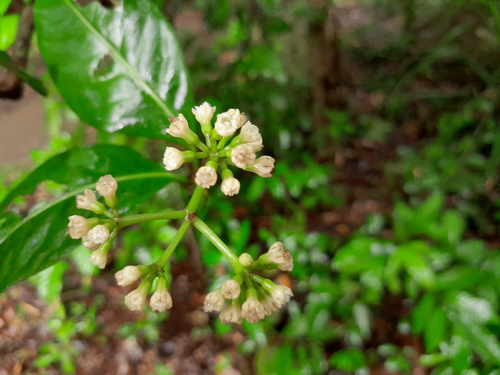
Ceodes umbellifera, also known by the synonym Pisonia umbellifera, is commonly called birdlime. This species includes the named variegated cultivar Ceodes umbellifera 'Variegata', which has leaves marbled with white, light green, and dark green. It is typically a large shrub or tree, though recorded heights vary across sources: most sources note it grows 4 to 12 metres tall, while some sources report the tallest known specimen reaches 20 metres, and one source notes a height of 28 metres. Mature individuals develop a spreading, rounded crown that can cover more than 20 feet. Its leaves are elliptic to ovate, 6 to 20 cm long and 4 to 10 cm wide. They have a hairless, glossy, papery texture, with 8 to 10 light-colored lateral veins per leaf side, with no distinctly contrasting dark veins. The thick petiole ranges from 0.5 to 5 cm long, and is sometimes exstipulate. Unvariegated plants have large, medium green leaves. Flowering begins in summer, with buds developing into a complex terminal inflorescence before blooming. Flower buds are around 6 cm tall, pale brown, and have a chickpea-like appearance. The inflorescence may be hairless or covered in fine silky hairs. Peduncles leading to buds and flowers measure 3.5 to 4 cm, and branch at the apex to form loose umbels or contracted panicles that hold 3 to 8 flowers, as described by botanist Debasmita Pramanick. The green, hairless pedicels that connect flowers or buds to the inflorescence are 1 to 2.5 mm long. Flowers have small pink or yellow petals arranged in a rounded funnel shape, with short white stems protruding from the center. Each flower has 1 to 4 lance-shaped bracts, which are membranous with a single main vein, joined at either the base or apex of the pedicel. The perianth is bell-shaped (campanulate), with reflexed triangular 5-lobes and short brown hairs, per Pramanick's description. Each flower has 6 to 14 protruding stamens with threadlike filaments. Each filament holds an orange, subglobose anther attached at its back, which splits longitudinally along its long axis at maturity to release pollen. After flowering, the plant produces small dark brown to purple, cylindrical, viscid fruit 2–4 cm long. The fruit gives the species its common name of birdlime: it secretes a sticky substance that can trap small birds, leaving them unable to fly away. The fruit are indehiscent, hairless, leathery (coriaceous), marked with 5 vertical ribs, and borne on pedicels 4–10 cm long. Ceodes umbellifera can be distinguished from similar related species such as Pisonia sechellarum by the reflexed perianth lobes of its pistillate flowers and its inconspicuous anthrocarpal glands. This species is native to Australia, southern China, Thailand, Vietnam, Taiwan, Malaysia, the Philippines, Indonesia, Hawaii, and many Polynesian islands; it also occurs naturally in parts of Africa and Madagascar. In Australia, it is found along the east coast in New South Wales and Queensland, where it is widespread but not common. In New South Wales, it occurs in the North Coast and Central Coast regions, and grows mostly in rainforests north of the Shoalhaven region. In Hawaii, where it is called pāpala or pāpala kēpau, it is particularly endemic to Kauaʻi, Oʻahu, Lānaʻi and Maui, and has also been found on the main Hawaiian island and Molokaʻi. In Hawaii, it grows in areas that receive 50–100 inches of annual rainfall, at elevations between 150 and 1999 feet above sea level. Its ideal growing temperature ranges from around 16 to 20 degrees Celsius. It can only be grown in frost-free environments and gardens, and does not tolerate sustained extreme heat. Rare accounts note the plant can survive temperatures as low as 26 degrees Fahrenheit. It requires high humidity and moderate moisture, though established plants are drought tolerant. It grows best in reliably moist soil high in potassium, but can survive in dry soil if watered occasionally. It needs moderate sunlight, with most cultivation guidance recommending part shade or full sun. When grown as an indoor plant, it is recommended to receive four hours of direct sunlight per day, with bright light for the remainder of the day. In the wild, it is most often found in rainforests, on islands, along coastlines, and in shady, moist gullies, so it occurs mainly in countries with tropical regions. The sticky sap exuded by the fruit sticks to passing wildlife, and often traps small animals including birds, reptiles, and insects, which may then starve to death. Most trapped animals are seabirds that live on offshore islands, though there are also records of mainland birds becoming stuck. For example, scientists in Goldsborough Valley, south of Cairns, Queensland, Australia, found a female Buff-breasted Paradise Kingfisher that was completely immobilized by the sticky substance, unable to even flap her wings. It is generally accepted that the birdlime is an adaptation to aid pollination: pollen adheres to trapped birds and is deposited elsewhere to grow new plants. Some botanists suggest the extreme stickiness may have additional evolutionary advantages. Since the species is widespread in tropical island rainforests, where soils are often low in fertility and nutrients, trapping and killing animals may create pockets of nutrients in surrounding soil to support growing seedlings. Unverified, unrepeated claims from some sources state that elephants sometimes break open the tree's soft wood to drink the sap with relish, and that sheep that eat the plant develop a golden color on their teeth that looks like gold. Indigenous Hawaiians used this plant for multiple traditional purposes: its leaves are used as a general remedy for digestive issues and childhood diseases. The Li ethnic group of Hainan Province, China, also uses it in traditional medicine. According to Lavaud and Beauvir's paper on saponins found in the species' leaves, in Vanuatu leaves of the species (then called Pisonia umbellifera) are used to treat ciguatera poisoning, and are also used as green manure. Melanesian market gardeners reportedly bury the species' leaves in soil to control phytophage nematodes in crops. The potential medicinal properties of this species have been the subject of scientific study. One study found that compounds extracted from its leaves may have antitubercular activity under certain conditions. Another study tested the anti-inflammatory and cytotoxic activities of compounds isolated from the plant's stems, and found no notable results.