About Centurio senex Gray, 1842
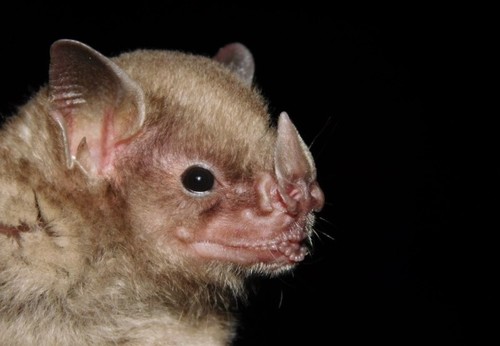
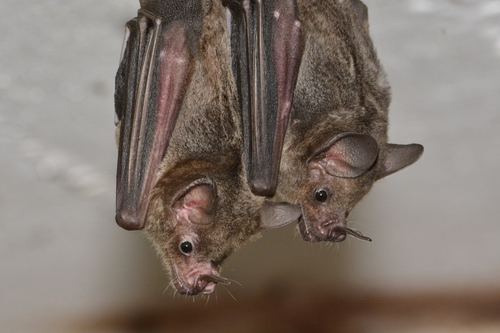
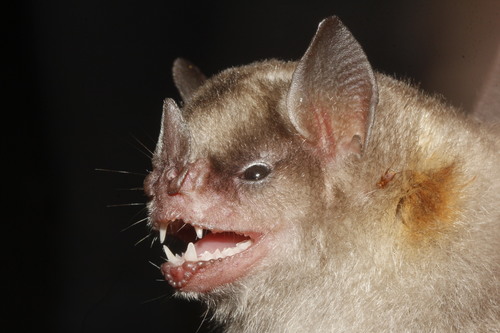
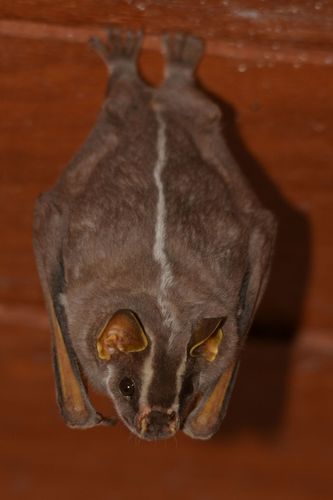
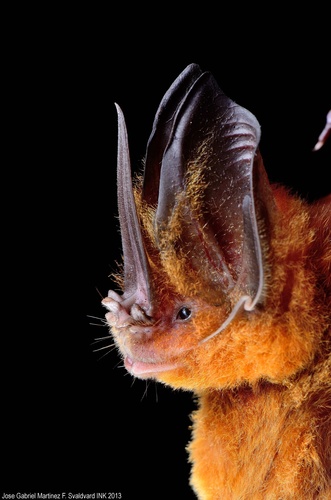
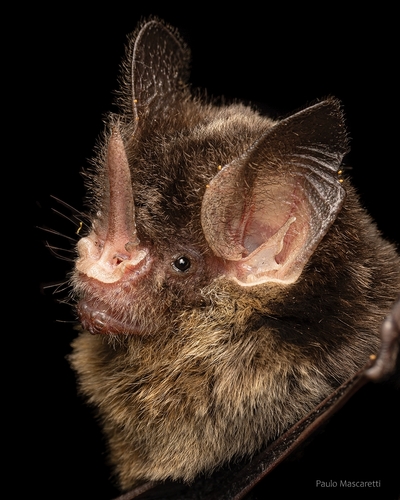
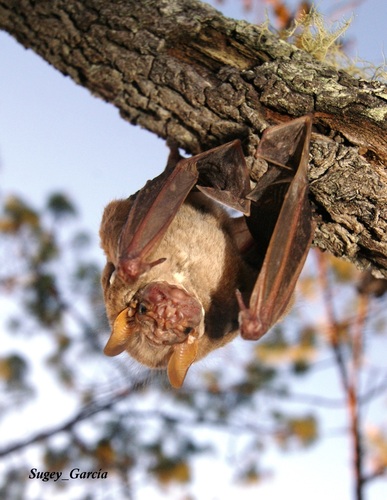
Centurio senex, commonly called the wrinkle-faced bat, is a medium-sized, tail-less bat. It typically has fur that ranges from drab brown to yellowish-brown, and weighs around 17 grams. Its face is hairless and covered by convoluted outgrowths of skin, which gives the species its common wrinkle-faced name. These skin flaps are more prominent in males than in females. Males also have a skin mask that they can use to cover their face. The wrinkle-faced bat has storage pouches inside its mouth that let it store fruit. The subspecies Centurio senex subsp. greenhalli differs from the more widespread nominate subspecies Centurio senex subsp. senex by being larger, having a more domed braincase, a better developed sagittal crest, and a relatively shorter maxillary toothrow. The skull of Centurio senex is extremely short and wide. This structure is thought to allow the species to produce bite forces up to 20% higher than other bats of a similar body size. Out of all leaf-nosed bats, Centurio senex can generate the largest bite force relative to its size. Centurio senex subsp. senex is distributed across Belize, Colombia, Costa Rica, El Salvador, Guatemala, Honduras, Mexico, Nicaragua, Panama, and Venezuela. Centurio senex subsp. greenhalli is only found in Trinidad and Tobago. For reproduction, female Centurio senex are thought to be both polyestrous and asynchronous. Pregnant females have been recorded every month between January and August, with the exception of May. Males release a musky odour from their chin area to attract females. The sperm morphology of this species is unique: the sperm head has a rounded nucleus and an extremely pointed acrosome. Recent research on the species in Costa Rica suggests that wrinkle-faced bats exhibit lek mating.