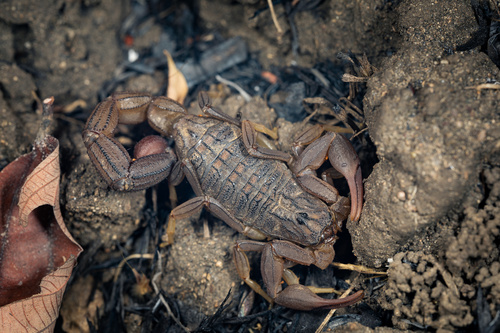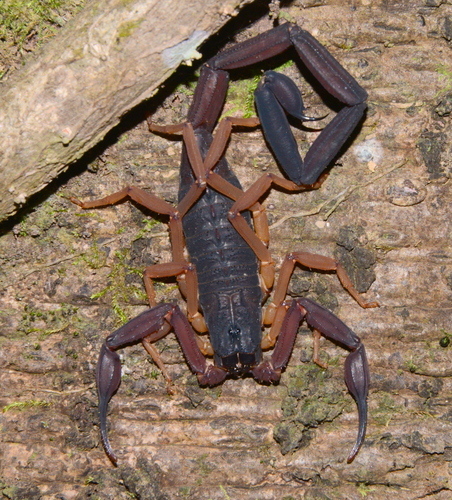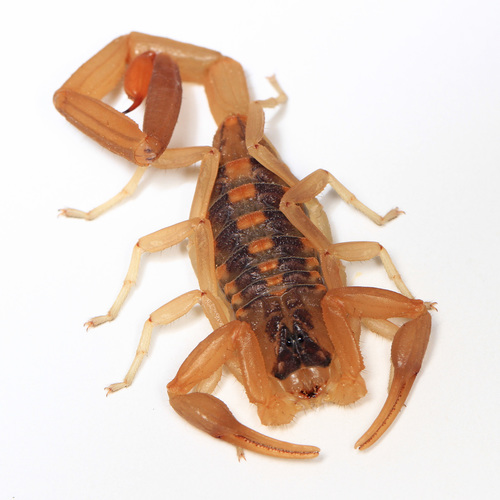
About Centruroides vittatus (Say, 1821)
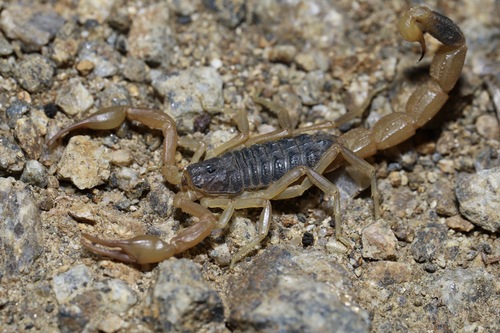
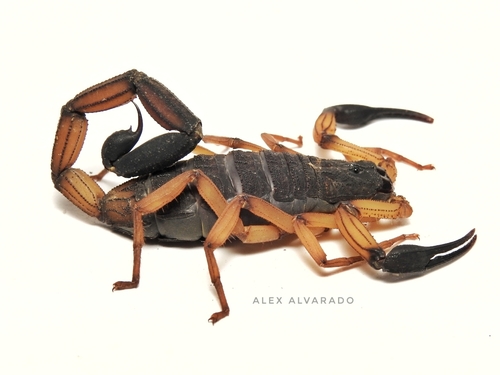
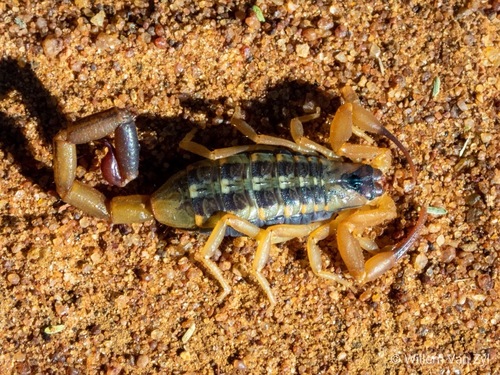
The striped bark scorpion, with the scientific name Centruroides vittatus, is an extremely common scorpion found across the midsection of the United States and northern Mexico. It is probably the most frequently encountered scorpion in the United States. The natural geographic range of C. vittatus covers several adjoining South-Central U.S. states and northern Mexico. Starting in the northern Mexico border states of Chihuahua, Coahuila, Nuevo León, and Tamaulipas, the range of C. vittatus extends northward through Texas, Oklahoma, and Kansas, reaching as far north as Thayer County, Nebraska. The range also extends eastward from the Sangre de Cristo Mountains and Rio Grande in New Mexico and southern Colorado to the Missouri and Mississippi Rivers in Missouri and Louisiana. In total, the natural range includes the U.S. states of Arkansas, Colorado, Kansas, Illinois, Louisiana, Mississippi, Missouri, Nebraska, New Mexico, Oklahoma, Florida, Georgia, and Texas. C. vittatus has also been reported in locations that do not fall within its described natural geographic distribution. Outside of its natural range, populations are only found in specific cities, so it is considered likely that human activity introduced C. vittatus to these areas. These out-of-range locations include Harrison County, Iowa; Marshall and Calloway Counties, Kentucky; East Baton Rouge Parish and Orleans Parish, Louisiana; Lamar, Pike, and Rankin Counties, Mississippi; Clark County, Missouri; Dare, Nash, and Wake Counties, North Carolina; and Rutherford and Shelby Counties, Tennessee. Additional sightings have been recorded in Maricopa County, Arizona; Contra Costa County, California; and Boulder County, Colorado. C. vittatus’s wide geographic range lets it occupy desert, deciduous forest, coniferous forest, and temperate grassland biomes. During the day, they can be found in crevices under rocks and surface debris, within vegetation, and in old rural structures such as sheds and barns, as well as inside houses. At night, this species leaves its daytime shelter and can be found on open ground or in vegetation, such as microphyllous desert brushwood or other types. While the genus Centruroides indicates this is a semi-arboreal species, the striped bark scorpion spends a large amount of its time on the ground. Its terrestrial preference continues into the night, when it leaves its temporary shelter at or after sunset to forage for prey. Juveniles, however, spend a large amount of time in vegetation, likely to avoid predation that they are more vulnerable to. C. vittatus has a very varied diet that includes insects, smaller arachnids, and juveniles of its own species. It is preyed on by birds, reptiles, some mammals, and larger arachnids. Unlike most scorpion species, C. vittatus is social, which gives it more opportunities to mate and compete for mates. As a result, its reproduction process is both intricate and extensive. To begin, males perform dominance behavior to compete for mating. They face off in a confrontation that involves tail-waving and shifting position until one male retreats. Once one male has established that he will mate, he begins the first courtship step with the female, called promenade a deux (PAD). During this step, the smaller male maneuvers the female to a location where he can deposit his spermatophore — a small capsule holding the male's sperm — for the female to receive. This step determines whether the female will accept the male's spermatophore, as the male must hold the female long enough to guide her over the spermatophore. Larger males tend to be more successful at maneuvering the female than smaller males. If the male successfully maneuvers the female into position, the pair moves to the next stage, where they join together and rub their chelicerae in the "kiss" stage, during which the female takes up the spermatophore. The female then has a gestation period of about 8 months, after which she gives birth to live offspring. The young stay on the protection of her back for at least their first molt.